
Bill Gates - Bill & Melinda Gates Foundation Trust Portfolio in 2026: Top Holdings & Recent Changes
Welcome to the Value Sense Blog, your resource for insights on the stock market! At Value Sense, we focus on intrinsic value tools and offer stock ideas with undervalued companies. Dive into our research products and learn more about our unique approach at valuesense.io
Explore diverse stock ideas covering technology, healthcare, and commodities sectors. Our insights are crafted to help investors spot opportunities in undervalued growth stocks, enhancing potential returns. Visit us to see evaluations and in-depth market research.
Bill Gates, through the Bill & Melinda Gates Foundation Trust, showcases his disciplined approach to long-term investing in the latest 13F filing. His $36.6B Q3 2025 portfolio reflects a pattern of significant reductions across key holdings, signaling a cautious rebalancing amid market highs while maintaining ultra-high conviction in a handful of quality names.
Portfolio Overview: Extreme Concentration with Proven Endurance
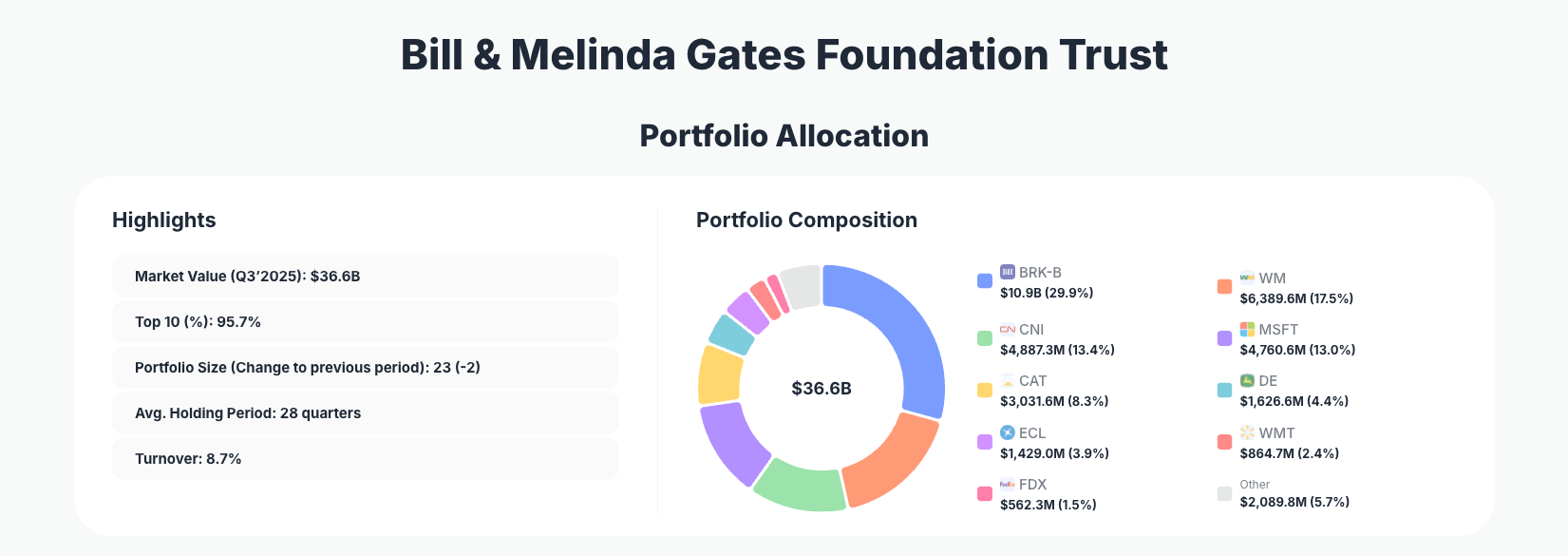
Portfolio Highlights (Q3’2025): - Market Value: $36.6B - Top 10 Holdings: 95.7% - Portfolio Size: 23 -2 - Average Holding Period: 28 quarters - Turnover: 8.7%
The Gates Foundation portfolio exemplifies extreme concentration, with the top 10 holdings commanding 95.7% of the total value—a level of focus that demands unwavering confidence in each position. This structure has defined the strategy for years, prioritizing a select group of durable businesses over broad diversification. The recent reduction in portfolio size to 23 positions -2 further underscores a pruning approach, eliminating underperformers to sharpen focus.
Low turnover at 8.7% paired with an impressive average holding period of 28 quarters highlights a buy-and-hold philosophy rooted in intrinsic value. Gates' moves in Q3 2025, dominated by reductions rather than additions, suggest profit-taking or risk management in an elevated market, yet the core remains intact. Tracking this via ValueSense reveals how such concentration has delivered steady compounding for decades.
This setup aligns with Gates' known preference for oligopoly-like businesses with strong moats, as seen in repeated trims across cyclical and tech exposures. Investors following the Gates Foundation portfolio can glean lessons in patience and position sizing.
Top Holdings Breakdown: Reductions Dominate the Narrative
The portfolio leads with Berkshire Hathaway (BRK-B) at 29.9%, reduced by 9.78%, maintaining its anchor role as a diversified conglomerate proxy. Waste Management (WM) follows at 17.5% after a 10.24% trim, reflecting ongoing conviction in essential services. Canadian National Railway (CNI) (13.4%, Reduce 5.47%) and Microsoft (MSFT) (13.0%, a sharp Reduce 64.91%) show trims in transportation and tech, potentially signaling valuation concerns.
Further down, Caterpillar (CAT) at 8.3% was cut by 13.60%, alongside Walmart (WMT) (2.4%, Reduce 7.70%) and FedEx (FDX) (1.5%, Reduce 5.92%). Smaller changes include Waste Connections (WCN) (1.0%, Reduce 5.12%), Kraft Heinz (KHC) (0.2%, Reduce 5.72%), and Hormel Foods (HRL) (0.1%, Reduce 5.01%).
Stable positions bolster the core: Deere & Company (DE) (4.4%, No change), Ecolab (ECL) (3.9%, No change), and Coca-Cola FEMSA (KOF) (1.4%, No change). These 13 holdings capture the bulk of activity, blending reductions in cyclicals with holds in industrials and consumer staples.
What the Portfolio Reveals About Gates' Strategy
Gates' Q3 moves paint a picture of disciplined risk management over aggressive expansion. Key themes emerge:
- Quality moats in essential industries: Heavy emphasis on waste management (WM, WCN), rail (CNI), and heavy machinery (CAT, DE) points to bets on recession-resistant operations with pricing power.
- Tech exposure dialed back: The massive 64.91% cut in MSFT suggests caution on high valuations, shifting toward tangible assets.
- Geographic diversification: North American focus with Canadian rail and Mexican bottler KOF, balancing U.S. centrism.
- Low dividend chase: Holdings like WMT and KHC provide yields, but growth moats drive selections.
- Risk via trims: Uniform reductions indicate portfolio rebalancing, not panic selling, with turnover at 8.7% preserving long-term orientation.
This reveals a strategy favoring predictable cash flows from oligopolistic leaders, even as markets climb.
Most investors waste time on the wrong metrics. We've spent 10,000+ hours perfecting our value investing engine to find what actually matters.
Want to see what we'll uncover next - before everyone else does?
Find Hidden Gems First!
Portfolio Concentration Analysis
| Position | Value | % of Portfolio | Recent Change |
|---|---|---|---|
| Berkshire Hathaway Inc. (BRK-B) | $10.9B | 29.9% | Reduce 9.78% |
| Waste Management, Inc. | $6,389.6M | 17.5% | Reduce 10.24% |
| Canadian National Railway Company | $4,887.3M | 13.4% | Reduce 5.47% |
| Microsoft Corporation | $4,760.6M | 13.0% | Reduce 64.91% |
| Caterpillar Inc. | $3,031.6M | 8.3% | Reduce 13.60% |
| Deere & Company | $1,626.6M | 4.4% | No change |
| Ecolab Inc. | $1,429.0M | 3.9% | No change |
| Walmart Inc. | $864.7M | 2.4% | Reduce 7.70% |
| FedEx Corporation | $562.3M | 1.5% | Reduce 5.92% |
| Coca-Cola FEMSA, S.A.B. de C.V. | $516.4M | 1.4% | No change |
This table underscores the portfolio's hallmark concentration, with BRK-B alone at nearly 30% and the top five exceeding 82%. Reductions across most leaders—like the double-digit cuts in WM and CAT—signal tactical de-risking without abandoning the thesis. Stable holdings like DE and ECL provide ballast, reinforcing that Gates views these as multi-decade compounds.
Such skew amplifies returns from winners but demands precise selection—evident in the 28-quarter hold average. For followers, this concentration validates deep research into moats over diversification for safety.
Investment Lessons from Bill Gates' Foundation Strategy
Gates' approach offers timeless principles for patient investors:
- Prioritize moats in boring businesses: Waste, rail, and machinery dominate for their essential, oligopolistic nature—durability trumps hype.
- Trim winners proactively: Significant reductions like MSFT's 64.91% cut show discipline in taking profits at peaks.
- Long holding periods build wealth: 28 quarters average proves conviction pays, avoiding trading noise.
- Concentrate on understood names: 95.7% in top 10 demands intimate knowledge, echoing "invest within your circle of competence."
- Rebalance amid growth: Portfolio shrinkage to 23 positions highlights pruning for efficiency, not chasing breadth.
These lessons, trackable via ValueSense, suit value hunters seeking compounded returns.
Looking Ahead: What Comes Next?
With turnover at a modest 8.7% and widespread trims, the Foundation likely holds dry powder from sales for opportunistic buys. No new positions appeared in Q3, but freed capital from MSFT and CAT reductions positions it for undervalued industrials or staples. In a potentially volatile 2026, with economic slowdown risks, this setup favors defensive moats like waste and rail.
Current holdings in BRK-B and WM offer resilience, while trims reduce cyclical exposure. Watch for deployments into energy transition plays or international value, aligning with Gates' philanthropic lens on sustainable infrastructure.
FAQ about Bill Gates' Gates Foundation Portfolio
Q: Why did the Gates Foundation drastically reduce Microsoft by 64.91%?
The sharp trim in MSFT (from a larger prior stake) likely reflects profit-taking after strong gains, rebalancing away from tech valuations amid broader market peaks. It still holds 13.0%, showing enduring faith.
Q: What explains the portfolio's 95.7% concentration in the top 10?
This ultra-focused structure stems from high-conviction bets on moat-heavy firms like BRK-B and WM, prioritizing quality over diversification for superior long-term returns.
Q: How does Bill Gates select holdings like waste management stocks?
Gates favors essential services with wide moats and steady cash flows—WM 17.5% and WCN exemplify recession-proof oligopolies aligned with infrastructure needs.
Q: What sectors dominate, and why the industrials tilt?
Industrials (rail, machinery) and consumer staples lead, with trims in cyclicals like CAT. This reflects a defensive posture favoring durable demand over growth sectors.
Q: How can I track the Gates Foundation portfolio and 13F filings?
Use ValueSense at https://valuesense.io/superinvestors/gates-foundation for real-time 13F updates, changes, and analysis. Note the 45-day reporting lag means Q3 data reflects decisions from late 2025.
Explore More Investment Opportunities
For investors seeking undervalued companies with high fundamental quality, our analytics team provides curated stock lists:
📌 50 Undervalued Stocks (Best overall value plays for 2026)
📌 50 Undervalued Dividend Stocks (For income-focused investors)
📌 50 Undervalued Growth Stocks (High-growth potential with strong fundamentals)
🔍 Check out these stocks on the Value Sense platform for free!