
Harry Burn - Sound Shore Portfolio Q3'2025: Top Holdings & Recent Changes
Welcome to the Value Sense Blog, your resource for insights on the stock market! At Value Sense, we focus on intrinsic value tools and offer stock ideas with undervalued companies. Dive into our research products and learn more about our unique approach at [valuesense.io]
Explore diverse stock ideas covering technology, healthcare, and commodities sectors. Our insights are crafted to help investors spot opportunities in undervalued growth stocks, enhancing potential returns. Visit us to see evaluations and in-depth market research.
Harry Burn - Sound Shore continues to apply a disciplined value investing lens across financials, healthcare, and cyclicals. Their Q3’2025 portfolio shows a mix of measured de-risking in large financials, profit-taking in prior winners, and fresh conviction in high-quality technology and information services, all within a diversified $3.0B U.S. equity book.
Explore the full Sound Shore portfolio on ValueSense
Portfolio Overview: Cyclical Value with Measured Rotation
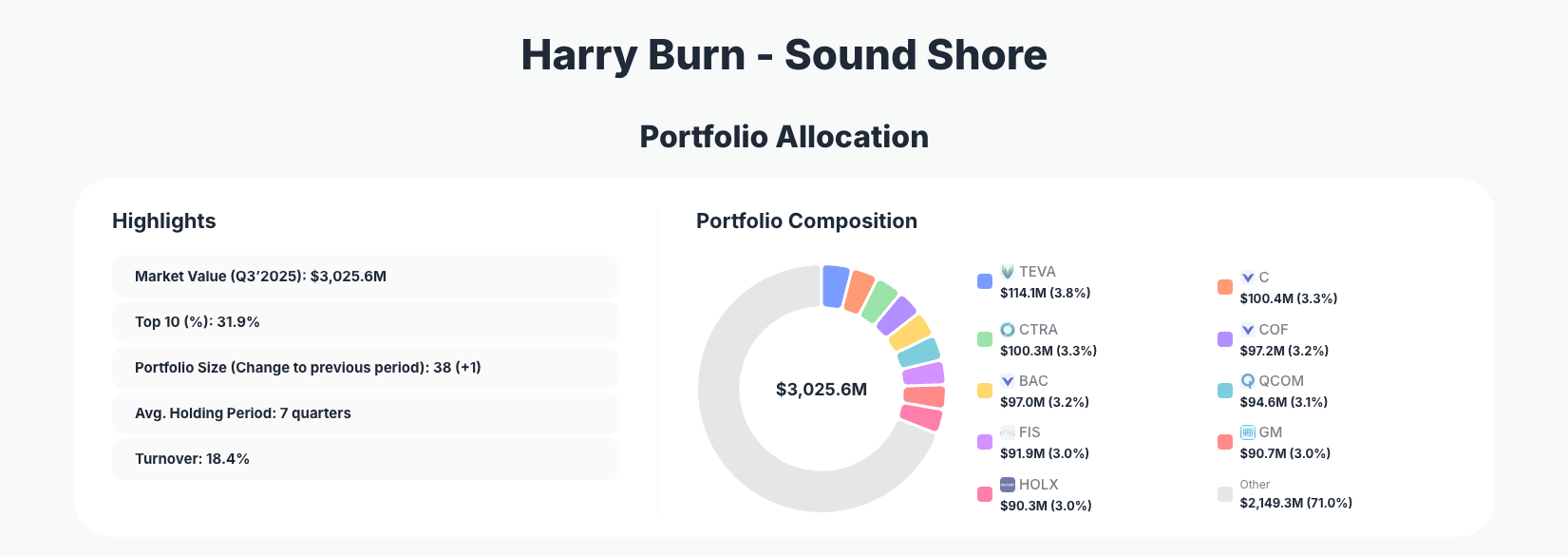
Portfolio Highlights (Q3’2025): - Market Value: $3,025.6M
- Top 10 Holdings: 31.9%
- Portfolio Size: 38 +1
- Average Holding Period: 7 quarters
- Turnover: 18.4%
The Q3’2025 Sound Shore portfolio remains diversified, with the top 10 positions accounting for 31.9% of assets—moderately concentrated but far from the ultra-focused style of some superinvestors. A 38-position book, up by one name this quarter, underscores a preference for broad exposure across sectors while still allowing meaningful sizing in highest-conviction ideas.
An average holding period of 7 quarters and turnover of 18.4% indicate a mid-term, valuation-driven approach rather than trading around short-term noise. The team is willing to hold positions through full value realization cycles, yet the latest 13F snapshot shows they are not afraid to scale back when risk/reward skews less favorably—especially in financials.
Sector-wise, Q3 activity in the Sound Shore portfolio highlights a tilt toward: - Financials (Citigroup, Bank of America, Capital One, Berkshire Hathaway) - Healthcare and pharma (Teva, Hologic) - Energy and industrial cyclicals (Coterra, General Motors) - Select high-quality tech / information services (QUALCOMM, Fidelity National Information Services)
This blend is consistent with a classic value style: cyclical and financial exposure balanced with defensive healthcare and cash-generative tech platforms.
Top Holdings Overview: Financials Trimmed, Tech and Compounders Added
The most active part of Q3’2025 positioning appears in the 10 holdings with explicit changes, all of which sit in the upper tier of the book.
The portfolio is led, within the disclosed top-changers group, by Teva Pharmaceutical Industries Limited at 3.8% of assets, where Sound Shore executed a “Reduce 5.51%” trim while still keeping it a core holding at $114.1M. Large-cap U.S. financials feature prominently: Citigroup 3.3% was cut by 29.61%, and Capital One Financial 3.2% saw a 14.20% reduction, signaling a cautious stance toward credit and rate-sensitive exposure at current prices.
Energy exposure via Coterra Energy 3.3% was slightly trimmed (Reduce 3.34%), reflecting more of a fine-tune than a thesis reversal. In contrast, the reduction in Bank of America is substantial—Reduce 74.15%—bringing the position to 3.2% and $97.0M, a notable de-risking move within major U.S. banks.
On the buy side, Sound Shore is leaning into quality tech and information infrastructure. QUALCOMM is a straight “Buy” at 3.1% of the portfolio and $94.6M, suggesting conviction in its cash flows and role in connectivity and mobile semiconductors. Meanwhile, Fidelity National Information Services—a key fintech and payments infrastructure provider—was “Add 24.40%” to reach 3.0% of assets and $91.9M, reinforcing the theme of owning critical transaction and data rails at value prices.
Cyclical industrial and consumer exposure remains present but selectively trimmed. General Motors at 3.0% $90.7M was modestly reduced (Reduce 3.33%), and healthcare diagnostics play Hologic at 3.0% $90.3M also saw a small “Reduce 3.26%”, likely locking in gains while preserving core exposure.
One of the most interesting moves is in Berkshire Hathaway Inc. (BRK-B), a diversified financial/industrial compounder. Sound Shore “Add 52.74%” to this position, taking it to 3.0% of the portfolio with $90.1M invested. That sizable increase suggests a preference for Berkshire’s diversified, capital-allocation-driven model as they scale back direct bets on individual banks like Bank of America and Citigroup.
Together, these 10–11 key holdings and changes paint a picture of a manager: - Trimming risk in big banks and select cyclicals - Maintaining but moderating exposure to pharma and healthcare - Leaning into high-quality tech and financial infrastructure - Using Berkshire Hathaway as a diversified financial and industrial anchor
What the Portfolio Reveals About Current Strategy
Sound Shore’s Q3’2025 moves reveal several strategic themes:
- Risk-aware financials exposure
Reductions in Citigroup, Capital One, and especially Bank of America suggest a more selective stance on U.S. financials. Rather than abandoning the sector, they appear to be concentrating into perceived stronger risk/reward profiles, partly via Berkshire Hathaway. - Value-oriented tech and infrastructure
The Buy in QUALCOMM and the Add 24.40% in Fidelity National Information Services reflect a value lens applied to durable tech franchises: critical IP, mission-critical software, and payment/data infrastructure rather than speculative growth. - Balanced cyclicals with controlled trims
Names like Coterra Energy and General Motors are still solidly in the book, but the slight “Reduce” actions point to active risk management as macro and commodity conditions evolve. - Healthcare as a defensive value anchor
Teva and Hologic remain meaningful positions, even after trims, providing exposure to healthcare demand with valuation upside rather than pure growth at any price.
Overall, the Q3’2025 Sound Shore portfolio is consistent with patient, valuation-driven stock picking, rotating within sectors rather than making wholesale macro calls.
Portfolio Concentration Analysis
Using the disclosed top 10 holdings (ranks 2–10):
| Position | Value | % of Portfolio | Recent Change |
|---|---|---|---|
| Teva Pharmaceutical Industries Limited (TEVA) | $114.1M | 3.8% | Reduce 5.51% |
| Citigroup Inc. (C) | $100.4M | 3.3% | Reduce 29.61% |
| Coterra Energy Inc. (CTRA) | $100.3M | 3.3% | Reduce 3.34% |
| Capital One Financial Corporation (COF) | $97.2M | 3.2% | Reduce 14.20% |
| Bank of America Corporation (BAC) | $97.0M | 3.2% | Reduce 74.15% |
| QUALCOMM Incorporated (QCOM) | $94.6M | 3.1% | Buy |
| Fidelity National Information Services, Inc. (FIS) | $91.9M | 3.0% | Add 24.40% |
| General Motors Company (GM) | $90.7M | 3.0% | Reduce 3.33% |
| Hologic, Inc. (HOLX) | $90.3M | 3.0% | Reduce 3.26% |
With 31.9% of assets in the top 10 and individual positions clustered tightly between 3.0% and 3.8%, Sound Shore is even-weighting its core ideas rather than running a single massive “hero” position. That structure spreads idiosyncratic risk while still making each idea matter to overall returns.
Notably, several of the largest weights are also the ones being actively trimmed (e.g., BAC, C, COF), while fresh or increased bets like QCOM and FIS sit just behind them. This pattern is typical of a manager rebalancing from matured value ideas into newly attractive opportunities while maintaining diversified top-of-book exposure.
Investment Lessons from Harry Burn’s Sound Shore Approach
Several practical takeaways emerge from studying the Q3’2025 Sound Shore portfolio:
- Value discipline with sector breadth
Instead of concentrating only in one or two sectors, Sound Shore applies a similar value framework across financials, energy, industrials, healthcare, and tech. The lesson: a value lens can be sector-agnostic. - Trim, don’t necessarily exit, when risk/reward compresses
Moves like “Reduce 74.15%” in BAC and smaller trims in GM and TEVA show a willingness to reduce exposure significantly without abandoning a thesis outright. - Embrace quality tech when it’s a value, not a fad
Adding to QUALCOMM and FIS demonstrates that value investing is not anti-tech; it is about the price paid vs. cash flows and durability. - Use diversified compounders to manage single-name risk
Scaling up Berkshire Hathaway while trimming individual banks is a case study in swapping concentrated single-name exposure for a broad, high-quality financial and industrial compounder. - Moderate turnover with multi-year horizons
A 7-quarter average holding period and sub-20% turnover encourage investors to think in multi-year value realization cycles, not weeks or months.
Looking Ahead: What Comes Next?
While we only see positions as of quarter-end due to the 13F reporting structure, the current Sound Shore portfolio positions the fund for several potential scenarios:
- If rates remain elevated or credit spreads widen, trims in banks and consumer credit names may reduce downside, while exposure via BRK-B and diversified financial/data franchises remains intact.
- Continued adoption of digital payments and data infrastructure should benefit holdings such as FIS and QCOM, especially if they were bought at value multiples.
- Healthcare and pharma positions like TEVA and HOLX give some defensive ballast if macro conditions deteriorate.
- Cyclical holdings such as CTRA and GM retain upside optionality if economic growth and energy demand surprise to the upside.
Future quarters will show whether Sound Shore continues to rotate out of traditional banks into more diversified financials and infrastructure plays, or if current trims prove temporary amid shifting valuations.
FAQ about Harry Burn – Sound Shore Portfolio
Q: What were the most significant portfolio changes for Sound Shore in Q3’2025?
The largest moves include major reductions in Bank of America (Reduce 74.15%) and a sizable cut in Citigroup (Reduce 29.61%), alongside a 52.74% addition to Berkshire Hathaway (BRK-B) and a 24.40% increase in FIS, plus a new Buy in QCOM at the top of the book.
Q: How concentrated is the Sound Shore portfolio?
As of Q3’2025, the top 10 positions account for 31.9% of assets across 38 total holdings. Individual top holdings cluster around 3–4% each, indicating a diversified but conviction-weighted structure rather than a barbell of tiny positions and one or two huge bets.
Q: What does the portfolio say about Sound Shore’s sector strategy?
The portfolio shows meaningful exposure to financials, energy, industrials, healthcare, and tech-enabled infrastructure. The strategy appears to favor cyclical value and financials, balanced by healthcare and high-quality tech names like QCOM and FIS that provide recurring revenue and strong cash generation.
Q: How should investors interpret these 13F filings, given the reporting lag?
13F filings are reported with an SEC-mandated ~45-day lag after quarter-end.[1][2] This means positions in the Q3’2025 filing may have changed by the time investors review them. Use the data to understand strategy, position sizing, and long-term conviction, not as a real-time trading signal. Platforms like ValueSense track these filings systematically and visualize historical changes to give better context.[1][2][3][4][5][6][7][8]
Q: How can I track Sound Shore’s portfolio and any new moves going forward?
You can monitor updates to Harry Burn’s holdings via quarterly 13F filings and by using the ValueSense superinvestor tracker. Visit the dedicated page for Sound Shore at Sound Shore’s portfolio to see current holdings, historical changes, and detailed position analytics.
Explore More Investment Opportunities
For investors seeking undervalued companies with high fundamental quality, our analytics team provides curated stock lists:
📌 50 Undervalued Stocks (Best overall value plays for 2025)
📌 50 Undervalued Dividend Stocks (For income-focused investors)
📌 50 Undervalued Growth Stocks (High-growth potential with strong fundamentals)
🔍 Check out these stocks on the Value Sense platform for free!