
Mairs and Power Portfolio in 2026: Top Holdings & Recent Changes
Welcome to the Value Sense Blog, your resource for insights on the stock market! At Value Sense, we focus on intrinsic value tools and offer stock ideas with undervalued companies. Dive into our research products and learn more about our unique approach at valuesense.io
Explore diverse stock ideas covering technology, healthcare, and commodities sectors. Our insights are crafted to help investors spot opportunities in undervalued growth stocks, enhancing potential returns. Visit us to see evaluations and in-depth market research.
Mairs and Power continues to demonstrate why patient, disciplined investing remains one of the most effective paths to long-term wealth creation. Their Q3 2025 portfolio reveals a masterclass in balanced value investing, with $10.6 billion deployed across 248 carefully selected positions that reflect decades of investment discipline. Under the stewardship of fund manager Andrew Adams, this Minnesota-based firm has built a reputation for identifying quality businesses trading at reasonable valuations—and the latest quarterly moves show they're actively fine-tuning their positions in response to shifting market dynamics.
Portfolio Overview: Disciplined Rebalancing in a Tech-Heavy Market
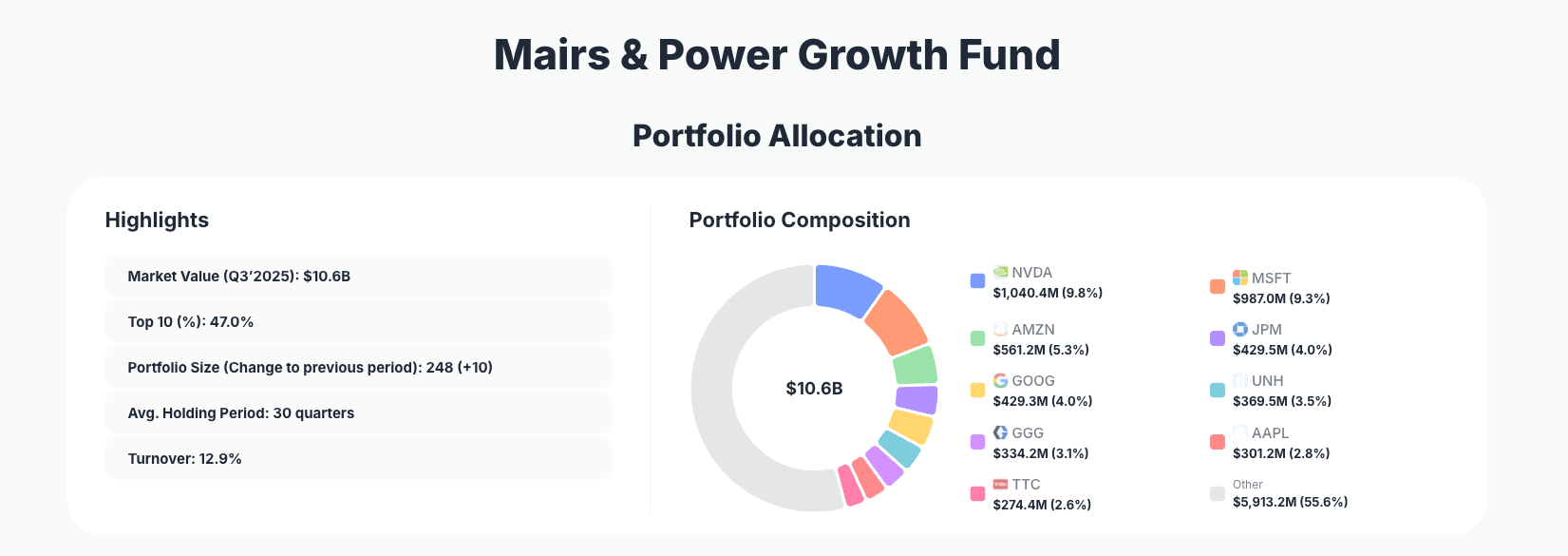
Portfolio Highlights (Q3 2025): - Market Value: $10.6B - Top 10 Holdings: 47.0% - Portfolio Size: 248 +10 - Average Holding Period: 30 quarters (7.5 years) - Turnover: 12.9%
What immediately stands out about Mairs and Power's portfolio is the combination of meaningful diversification with strategic concentration. With 248 positions and a 47% weighting in the top 10 holdings, the firm maintains exposure to a broad range of opportunities while keeping significant capital deployed in their highest-conviction ideas. The 30-quarter average holding period—representing 7.5 years of average ownership—underscores a fundamental philosophy: quality businesses deserve patient capital.
The 12.9% turnover rate reveals disciplined rebalancing rather than reactive trading. This level of activity suggests the team is actively pruning underperformers and upgrading to better opportunities, yet maintaining core positions through market volatility. This approach has proven effective for long-term investors seeking to compound wealth without the friction costs of excessive trading.
Top Holdings Analysis: Tech Titans Meet Selective Pruning
The portfolio's composition reflects a sophisticated approach to navigating today's market environment. NVIDIA anchors the portfolio at 9.8% $1,040.4M, though Mairs and Power reduced this position by 4.07%—a signal that even in their highest-conviction tech holdings, they're taking profits and managing concentration risk. Microsoft follows closely at 9.3% $987.0M with a 4.95% reduction, suggesting a measured approach to AI-driven valuations that have soared in recent quarters.
The selective buying is equally telling. Amazon received a 2.53% addition, now representing 5.3% of the portfolio $561.2M, indicating confidence in the e-commerce and cloud computing giant's long-term trajectory. Apple saw a notable 3.52% increase to 2.8% $301.2M, suggesting the team views the tech giant as attractively valued despite its massive scale.
The financial sector shows more significant rebalancing. JPMorgan Chase experienced a substantial 9.29% reduction, dropping to 4.0% $429.5M—the most aggressive trim in the top 10. This move likely reflects profit-taking after strong performance and a reassessment of valuation relative to other opportunities. Alphabet saw a more modest 2.18% reduction to 4.0% $429.3M, maintaining meaningful exposure to the search and advertising powerhouse.
Healthcare positions show mixed activity. UnitedHealth Group received a 1.21% addition, now at 3.5% $369.5M, reflecting confidence in the diversified healthcare services provider. Eli Lilly was trimmed by 1.96% to 2.6% $273.3M, likely taking some profits from the pharmaceutical giant's strong performance.
Industrial and specialty positions round out the top 10. Graco was reduced by 1.08% to 3.1% $334.2M, while The Toro Company saw a 1.35% trim to 2.6% $274.4M. These moves suggest Mairs and Power is maintaining exposure to quality industrial businesses while managing overall portfolio concentration.
What the Portfolio Reveals About Current Strategy
The Q3 2025 portfolio moves paint a clear picture of Mairs and Power's investment philosophy in action:
Profit-Taking on Extended Valuations: The reductions in mega-cap tech stocks like NVIDIA and Microsoft, despite their quality, suggest the team believes valuations have stretched beyond reasonable levels. This isn't a loss of conviction in the businesses themselves, but rather disciplined capital allocation when prices exceed intrinsic value.
Selective Accumulation in Quality: The additions to Amazon and Apple, combined with the maintenance of large positions in Microsoft and NVIDIA, show the firm remains committed to owning the best businesses. The selectivity—adding to some while trimming others—reflects nuanced valuation judgments rather than blanket sector rotations.
Diversification Across 248 Holdings: With nearly a quarter of the portfolio outside the top 10, Mairs and Power maintains meaningful exposure to mid-cap and smaller opportunities that may offer better risk-reward profiles than mega-cap stocks. This breadth helps capture value opportunities that larger, more concentrated portfolios might miss.
Long-Term Holding Periods: The 30-quarter average holding period means the portfolio is built for compounding, not trading. Even with 12.9% turnover, the core positions are held through multiple market cycles, allowing the power of compound returns to work.
Disciplined Risk Management: The 12.9% turnover, combined with the broad portfolio of 248 positions, suggests a systematic approach to risk management. Rather than making dramatic sector bets, Mairs and Power adjusts positions incrementally as valuations and fundamentals evolve.
Most investors waste time on the wrong metrics. We've spent 10,000+ hours perfecting our value investing engine to find what actually matters.
Want to see what we'll uncover next - before everyone else does?
Find Hidden Gems First!
Portfolio Concentration Analysis
| Position | Value | % of Portfolio | Recent Change |
|---|---|---|---|
| NVIDIA Corporation | $1,040.4M | 9.8% | Reduce 4.07% |
| Microsoft Corporation | $987.0M | 9.3% | Reduce 4.95% |
| Amazon.com, Inc. | $561.2M | 5.3% | Add 2.53% |
| JPMorgan Chase & Co. | $429.5M | 4.0% | Reduce 9.29% |
| Alphabet Inc. | $429.3M | 4.0% | Reduce 2.18% |
| UnitedHealth Group Incorporated | $369.5M | 3.5% | Add 1.21% |
| Graco Inc. | $334.2M | 3.1% | Reduce 1.08% |
| Apple Inc. | $301.2M | 2.8% | Add 3.52% |
| The Toro Company | $274.4M | 2.6% | Reduce 1.35% |
| Eli Lilly and Company | $273.3M | 2.6% | Reduce 1.96% |
The concentration analysis reveals a portfolio in transition. The top 10 holdings represent 47% of assets, a meaningful but not extreme concentration level. What's particularly noteworthy is the activity within this group: six positions were reduced, three were increased, and none remained unchanged. This suggests Mairs and Power is actively managing valuations rather than passively holding winners.
The largest reduction—JPMorgan Chase's 9.29% trim—indicates the team may be concerned about financial sector valuations or sees better opportunities elsewhere. Conversely, the 3.52% addition to Apple and 2.53% addition to Amazon suggest selective confidence in these mega-cap names despite their size. This balanced approach to rebalancing is characteristic of mature, disciplined investment management.
Investment Lessons from Mairs and Power's Value Approach
Mairs and Power's Q3 2025 portfolio offers several timeless investment principles:
Quality Deserves Patient Capital: The 30-quarter average holding period demonstrates that truly great businesses are worth holding through multiple market cycles. Rather than trading in and out based on short-term noise, the firm compounds returns by owning excellent companies for years.
Valuation Discipline Trumps Conviction: Even in their largest positions, Mairs and Power will trim when valuations become extended. This shows that conviction in a business's quality doesn't override the fundamental principle that price matters. The reductions in NVIDIA and Microsoft, despite their excellence, prove this point.
Diversification Across 248 Names Reduces Single-Stock Risk: While the top 10 holdings represent 47% of assets, the remaining 238 positions provide meaningful diversification. This structure allows the firm to take meaningful positions in their best ideas while still capturing opportunities in less obvious places.
Systematic Rebalancing Captures Gains: The 12.9% turnover rate, applied consistently across a 248-position portfolio, creates a natural mechanism for taking profits from winners and redeploying to undervalued opportunities. This disciplined approach removes emotion from portfolio management.
Balance Growth and Value: The portfolio's mix of mega-cap growth stocks (NVIDIA, Microsoft, Amazon, Apple) with value-oriented industrials (Graco, Toro) and healthcare names shows that successful long-term investing doesn't require choosing between growth and value—it requires owning quality businesses at reasonable prices.
Looking Ahead: What Comes Next?
With $10.6 billion in assets and a 12.9% turnover rate, Mairs and Power has meaningful dry powder for redeployment each quarter. The recent additions to Amazon and Apple, combined with the significant trim in JPMorgan Chase, suggest the team is rotating capital toward technology and consumer-facing businesses while taking profits in financials.
The broader market environment in early 2026 presents both challenges and opportunities. If interest rates continue to decline as some expect, financial stocks like JPMorgan Chase may become more attractive—potentially explaining the recent trim as a tactical move ahead of a potential re-entry. Conversely, if technology valuations continue to compress, the reductions in NVIDIA and Microsoft may prove prescient, allowing the firm to redeploy at better prices.
The addition of 10 new positions (portfolio size grew from 238 to 248) suggests the team has identified new opportunities worth adding to the portfolio. These could be mid-cap or smaller-cap names that offer better risk-reward profiles than mega-cap stocks, consistent with the firm's value-oriented philosophy.
FAQ About Mairs and Power Portfolio
Q: Why did Mairs and Power reduce NVIDIA and Microsoft despite their quality?
A: The reductions reflect valuation discipline rather than a loss of conviction. When even excellent businesses become expensive relative to their intrinsic value, disciplined investors take profits. The 4.07% and 4.95% trims suggest the team believes these positions had become extended and that capital could be better deployed elsewhere.
Q: What does the 30-quarter average holding period tell us about Mairs and Power's strategy?
A: The 7.5-year average holding period demonstrates a commitment to long-term compounding. Rather than trading in and out of positions, the firm holds quality businesses through multiple market cycles, allowing the power of compound returns to work. This approach reduces trading costs and taxes while capturing the full upside of business growth.
Q: How does a 248-position portfolio with 47% in the top 10 balance concentration and diversification?
A: This structure allows Mairs and Power to take meaningful positions in their highest-conviction ideas (the top 10 at 47%) while maintaining broad diversification across 238 additional positions. This approach captures the benefits of both concentration—meaningful returns from best ideas—and diversification—reduced single-stock risk from the broader portfolio.
Q: What sectors dominate the Mairs and Power portfolio?
A: Technology (NVIDIA, Microsoft, Apple, Alphabet, Amazon) represents a significant portion of the top 10, reflecting the quality and scale of these businesses. However, the full 248-position portfolio includes meaningful exposure to healthcare (UnitedHealth, Eli Lilly), industrials (Graco, Toro), and financials (JPMorgan Chase), providing sector diversification.
Q: How can I track Mairs and Power's portfolio changes going forward?
A: You can monitor Mairs and Power's quarterly 13F filings on ValueSense, which provides detailed analysis of holdings, recent changes, and historical trends. Remember that 13F filings carry a 45-day reporting lag, so the positions disclosed may differ from the firm's real-time portfolio—but they remain invaluable for understanding the strategy's structure and evolution.
Explore More Investment Opportunities
For investors seeking undervalued companies with high fundamental quality, our analytics team provides curated stock lists:
📌 50 Undervalued Stocks (Best overall value plays for 2026)
📌 50 Undervalued Dividend Stocks (For income-focused investors)
📌 50 Undervalued Growth Stocks (High-growth potential with strong fundamentals)
🔍 Check out these stocks on the Value Sense platform for free!