
Matrix Asset Advisors Portfolio in 2026: Top Holdings & Recent Changes
Welcome to the Value Sense Blog, your resource for insights on the stock market! At Value Sense, we focus on intrinsic value tools and offer stock ideas with undervalued companies. Dive into our research products and learn more about our unique approach at valuesense.io
Explore diverse stock ideas covering technology, healthcare, and commodities sectors. Our insights are crafted to help investors spot opportunities in undervalued growth stocks, enhancing potential returns. Visit us to see evaluations and in-depth market research.
Matrix Asset Advisors continues to demonstrate disciplined portfolio management at an institutional scale. Their Q4 2025 portfolio reveals a sophisticated approach to managing $1.1 trillion in assets, with strategic adjustments across their top holdings that signal a measured shift in market positioning. Under the leadership of David Katz, the firm has maintained its focus on quality businesses while making tactical moves that reflect evolving market conditions and valuation opportunities.
Portfolio Overview: Strategic Rebalancing at Scale
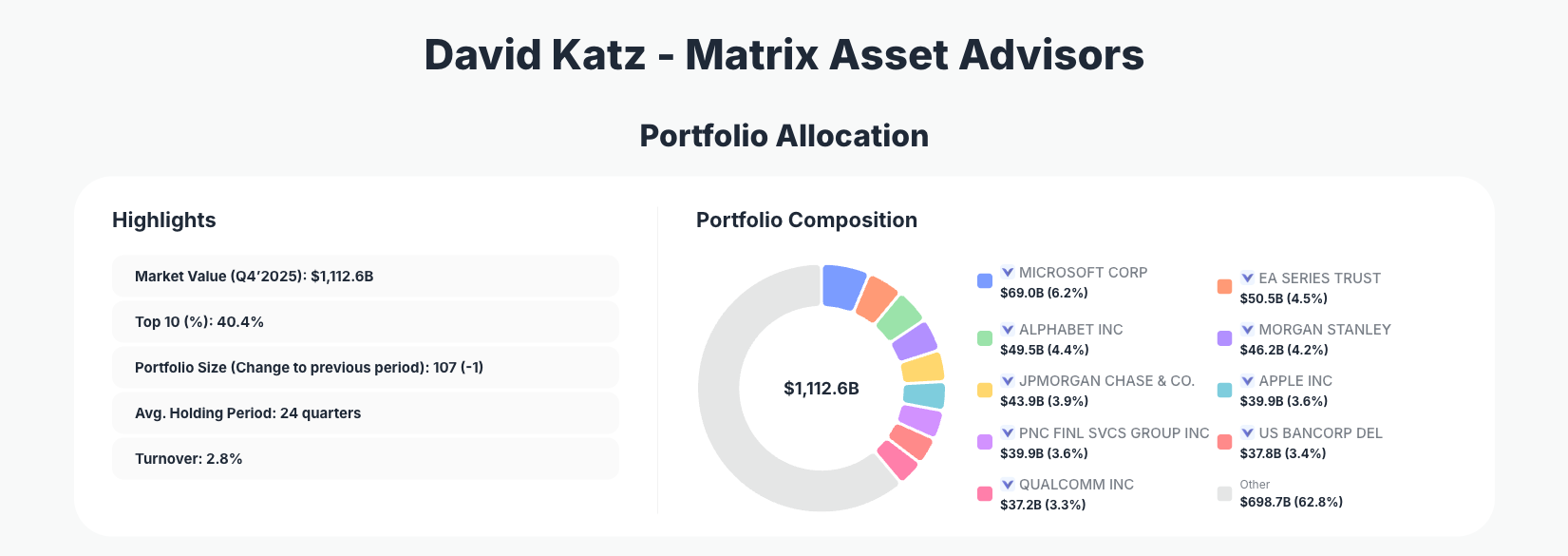
Portfolio Highlights (Q4 2025): - Market Value: $1,112.6B - Top 10 Holdings: 40.4% - Portfolio Size: 107 positions -1 - Average Holding Period: 24 quarters - Turnover: 2.8%
Matrix Asset Advisors' portfolio exemplifies the characteristics of a long-term value investor operating at scale. With an average holding period of 24 quarters (six years), the firm demonstrates conviction in its investment thesis while maintaining a remarkably low turnover rate of just 2.8%. This disciplined approach suggests that when Matrix does make changes, they are deliberate and meaningful. The slight reduction in portfolio size from 108 to 107 positions indicates selective pruning rather than aggressive portfolio restructuring.
The concentration of the top 10 holdings at 40.4% of the portfolio reflects a balanced approach—meaningful concentration in the firm's highest-conviction ideas while maintaining diversification across 107 total positions. This structure allows Matrix to deploy significant capital in its best ideas while managing risk through broader diversification. The $1.1 trillion portfolio size places Matrix among the largest institutional investors globally, making even small percentage adjustments represent billions of dollars in capital reallocation.
Top Holdings Analysis: Tech Leadership with Strategic Rebalancing
Matrix's portfolio is anchored by Microsoft Corp at 6.2% $69.0B, which received an addition of 0.55% during the quarter. This increase signals continued confidence in the technology giant's competitive moat and growth prospects. EA Series Trust (4.5%, $50.5B) also received a modest addition of 0.16%, suggesting selective buying in this position.
However, the quarter reveals more significant reductions in other major holdings. Alphabet Inc (4.4%, $49.5B) saw a 1.86% reduction, the largest decrease among the top holdings. Morgan Stanley experienced the most substantial cut at 2.95% reduction, bringing it to 4.2% of the portfolio $46.2B. JPMorgan Chase & Co. (3.9%, $43.9B) was reduced by 1.91%, while Apple Inc (3.6%, $39.9B) saw a 1.18% reduction.
On the buying side, PNC Financial Services Group Inc received an addition of 0.35%, maintaining its 3.6% position $39.9B. US Bancorp (3.4%, $37.8B) was reduced by 0.91%, while Qualcomm Inc (3.3%, $37.2B) received a 0.24% addition. Medtronic PLC (3.2%, $35.5B) rounded out the top 10 with a modest 0.29% reduction.
What the Portfolio Reveals About Current Strategy
The Q4 2025 adjustments reveal several strategic themes:
Financial Sector Repositioning: The significant reductions in Morgan Stanley and JPMorgan Chase, combined with selective additions to PNC Financial Services, suggest Matrix is rebalancing within the financial sector. This may reflect concerns about valuation levels in mega-cap banks or a preference for regional banking exposure.
Technology Selectivity: While Microsoft and Qualcomm received additions, the reduction in Alphabet signals that Matrix is being selective within the technology sector. This differentiation suggests the firm believes certain tech companies offer better risk-reward profiles than others at current valuations.
Healthcare Stability: The modest reduction in Medtronic indicates maintenance of healthcare exposure while trimming positions that may have appreciated significantly. This reflects a disciplined approach to position sizing and profit-taking.
Disciplined Capital Allocation: The low turnover rate and modest percentage changes indicate that Matrix is making incremental adjustments rather than dramatic shifts. This suggests confidence in the overall portfolio structure while fine-tuning exposure to specific opportunities.
Portfolio Concentration Analysis
| Position | Value | % of Portfolio | Recent Change |
|---|---|---|---|
| Microsoft Corp | $69.0B | 6.2% | Add 0.55% |
| EA Series Trust | $50.5B | 4.5% | Add 0.16% |
| Alphabet Inc | $49.5B | 4.4% | Reduce 1.86% |
| Morgan Stanley | $46.2B | 4.2% | Reduce 2.95% |
| JPMorgan Chase & Co. | $43.9B | 3.9% | Reduce 1.91% |
| Apple Inc | $39.9B | 3.6% | Reduce 1.18% |
| PNC Financial Services Group Inc | $39.9B | 3.6% | Add 0.35% |
| US Bancorp | $37.8B | 3.4% | Reduce 0.91% |
| Qualcomm Inc | $37.2B | 3.3% | Add 0.24% |
| Medtronic PLC | $35.5B | 3.2% | Reduce 0.29% |
The concentration table reveals a portfolio where the top 10 holdings represent $413.4 billion, or 40.4% of total assets. This level of concentration is significant but not extreme, reflecting a philosophy that combines conviction in top ideas with meaningful diversification. The largest position, Microsoft at 6.2%, is substantial enough to meaningfully impact returns but not so large as to create excessive single-stock risk.
The pattern of changes—selective additions to Microsoft, Qualcomm, and PNC Financial Services balanced against reductions in Alphabet, Morgan Stanley, and JPMorgan Chase—suggests Matrix is rotating capital toward positions it views as more attractive at current valuations. The fact that no position was eliminated entirely indicates the firm maintains conviction in all top 10 holdings, even those being trimmed.
Most investors waste time on the wrong metrics. We've spent 10,000+ hours perfecting our value investing engine to find what actually matters.
Want to see what we'll uncover next - before everyone else does?
Find Hidden Gems First!
Investment Lessons from Matrix Asset Advisors' Approach
Matrix Asset Advisors' portfolio demonstrates several critical investment principles:
Conviction Through Concentration: The firm's willingness to maintain 6.2% in Microsoft and 4.5% in EA Series Trust demonstrates that true conviction requires meaningful position sizing. However, this concentration is balanced with diversification across 107 total positions, showing that conviction doesn't mean recklessness.
Long-Term Holding Periods Create Compounding: With an average holding period of 24 quarters, Matrix allows its best ideas to compound over extended periods. This approach minimizes tax drag and transaction costs while allowing businesses to realize their full potential.
Disciplined Rebalancing Beats Market Timing: The low 2.8% turnover rate combined with strategic adjustments shows that Matrix doesn't chase trends but rather rebalances when valuations become attractive or unattractive. This disciplined approach has historically outperformed both buy-and-hold and frequent trading strategies.
Quality Across Sectors: The portfolio spans technology (Microsoft, Alphabet, Qualcomm), financial services (Morgan Stanley, JPMorgan Chase, PNC, US Bancorp), healthcare (Medtronic), and other sectors. This diversification reduces concentration risk while maintaining exposure to quality businesses across economic cycles.
Valuation Discipline: The selective reductions in mega-cap positions like Alphabet and JPMorgan Chase, combined with additions to Microsoft and Qualcomm, suggest Matrix is actively managing valuation risk. This indicates the firm believes certain positions have appreciated to levels where risk-reward is less attractive.
Looking Ahead: What Comes Next?
Matrix Asset Advisors' Q4 2025 positioning sets up several potential scenarios for future quarters:
Financial Sector Opportunities: The reductions in major banks suggest Matrix may be waiting for better entry points or has concerns about near-term valuations. If financial stocks decline, the firm's reduced exposure could provide dry powder for new investments.
Technology Selectivity: The divergent treatment of technology stocks—adding to Microsoft and Qualcomm while reducing Alphabet—suggests Matrix sees differentiated opportunities within the sector. This positioning allows the firm to benefit from technology strength while managing exposure to specific risks.
Regional Banking Thesis: The addition to PNC Financial Services suggests Matrix may see value in regional banks that have been overlooked by the market. This could indicate conviction in a thesis about regional banking recovery or relative valuation attractiveness.
Deployment Capacity: With a 2.8% turnover rate and $1.1 trillion in assets, Matrix has significant dry powder from natural portfolio rebalancing. The reduction in several major positions could provide capital for new opportunities if the firm identifies attractive valuations.
FAQ About Matrix Asset Advisors Portfolio
Q: Why did Matrix reduce positions in major banks like Morgan Stanley and JPMorgan Chase?
A: The reductions likely reflect valuation considerations rather than loss of conviction. At $1.1 trillion in assets, even small percentage changes represent billions of dollars. Matrix may believe these positions have appreciated to levels where risk-reward is less attractive, or the firm may be rotating capital toward other opportunities. The fact that these positions remain in the top 10 indicates continued belief in their quality.
Q: What does the addition to Microsoft signal about Matrix's outlook?
A: The 0.55% addition to Microsoft, bringing it to 6.2% of the portfolio, signals strong conviction in the company's competitive position and growth prospects. This is particularly notable given that Microsoft is already the largest holding, suggesting Matrix believes the company can continue to deliver returns that justify this concentration level.
Q: How does Matrix's 2.8% turnover compare to other large investors?
A: A 2.8% turnover rate is exceptionally low, indicating a buy-and-hold philosophy with minimal trading. For context, the average mutual fund has turnover rates of 50-100%, while index funds have near-zero turnover. Matrix's low turnover suggests the firm makes deliberate, conviction-based changes rather than frequent tactical adjustments.
Q: What is the significance of Matrix reducing its portfolio size from 108 to 107 positions?
A: The elimination of one position suggests selective pruning. Rather than maintaining positions out of inertia, Matrix appears to have exited a holding that no longer met the firm's investment criteria. This disciplined approach to portfolio management—eliminating positions that don't meet standards—is characteristic of quality-focused investors.
Q: How can I track Matrix Asset Advisors' portfolio changes?
A: ValueSense provides real-time tracking of Matrix's 13F filings, allowing you to monitor portfolio changes as they occur. The SEC requires institutional investors to file 13F forms within 45 days of quarter-end, so there is a reporting lag. ValueSense's platform makes it easy to compare quarter-over-quarter changes, track individual holdings, and understand the strategic implications of portfolio adjustments.
Explore More Investment Opportunities
For investors seeking undervalued companies with high fundamental quality, our analytics team provides curated stock lists:
📌 50 Undervalued Stocks (Best overall value plays for 2026)
📌 50 Undervalued Dividend Stocks (For income-focused investors)
📌 50 Undervalued Growth Stocks (High-growth potential with strong fundamentals)
🔍 Check out these stocks on the Value Sense platform for free!