
Philippe Laffont - Coatue Management Portfolio in 2026: Top Holdings & Recent Changes
Welcome to the Value Sense Blog, your resource for insights on the stock market! At Value Sense, we focus on intrinsic value tools and offer stock ideas with undervalued companies. Dive into our research products and learn more about our unique approach at valuesense.io
Explore diverse stock ideas covering technology, healthcare, and commodities sectors. Our insights are crafted to help investors spot opportunities in undervalued growth stocks, enhancing potential returns. Visit us to see evaluations and in-depth market research.
Philippe Laffont, founder and CEO of Coatue Management, continues to demonstrate why he's one of the most influential technology-focused investors on Wall Street. His Q3 2025 portfolio reveals a masterclass in concentrated growth investing, with $40.8 billion deployed across 74 carefully selected positions that reflect his signature conviction in artificial intelligence, semiconductors, and cloud infrastructure. The latest 13F filing shows aggressive positioning in mega-cap tech leaders alongside emerging opportunities, signaling Laffont's confidence in the structural tailwinds reshaping the technology landscape.
Portfolio Overview: Concentrated Conviction in the AI Era
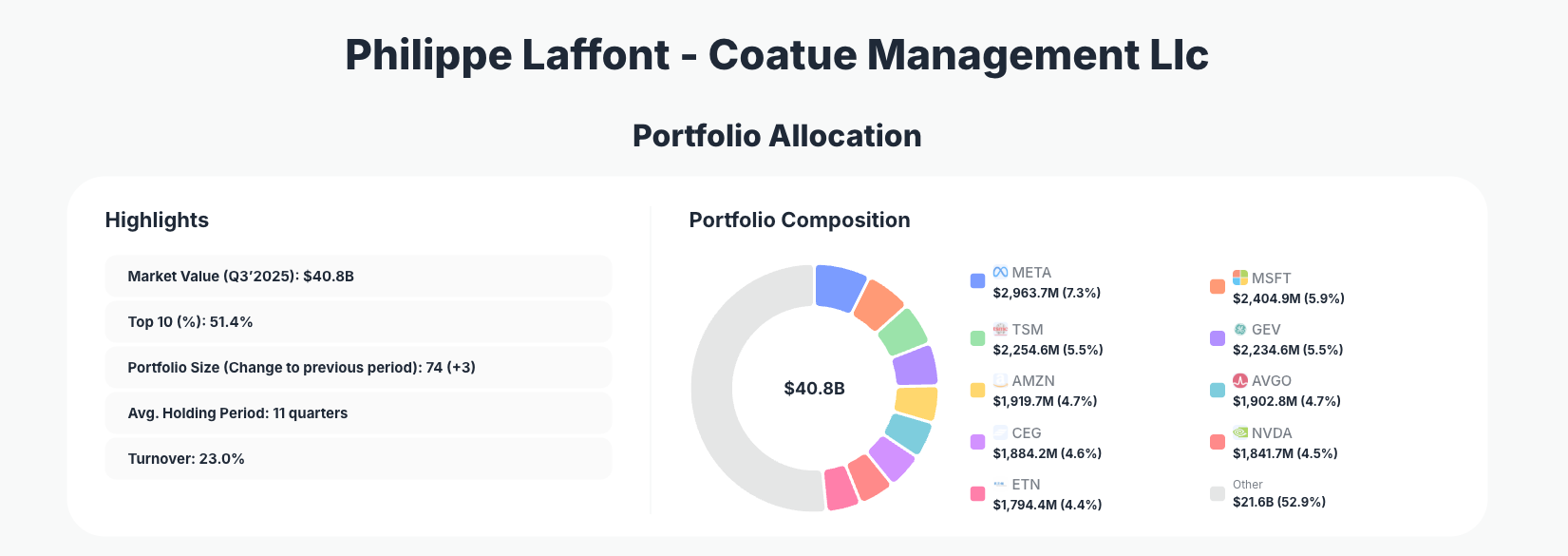
Portfolio Highlights (Q3 2025): - Market Value: $40.8B - Top 10 Holdings: 51.4% - Portfolio Size: 74 positions (+3 from prior quarter) - Average Holding Period: 11 quarters (approximately 2.75 years) - Turnover: 23.0%
Coatue's portfolio structure reveals a highly concentrated approach where the top 10 positions account for just over half of all assets. This concentration level is deliberate—it reflects Laffont's willingness to make substantial bets on companies where he identifies significant competitive advantages and growth potential. The addition of three new positions in Q3 2025, combined with a modest 23% turnover rate, suggests a balanced strategy that maintains core convictions while opportunistically adjusting to market conditions.
The 11-quarter average holding period demonstrates that despite Coatue's reputation as a growth investor, Laffont is not a short-term trader. This holding period indicates patience with thesis development and a willingness to allow compounding to work in his favor. The relatively low turnover further reinforces this discipline—Laffont is pruning underperformers and rebalancing, but not wholesale shifting his portfolio based on short-term market movements.
What's particularly striking about Coatue's latest positioning is the aggressive accumulation in artificial intelligence infrastructure plays. The portfolio shows meaningful increases in positions that directly benefit from AI adoption, suggesting Laffont believes the structural opportunity in AI is still in its early innings despite significant market enthusiasm.
Top Holdings Analysis: AI Infrastructure Dominates
The portfolio is anchored by Meta Platforms at 7.3% of the portfolio, with Laffont adding 9.65% to the position—a significant vote of confidence in the social media giant's AI capabilities and advertising resilience. Microsoft 5.9% received an even more aggressive boost with an 18.07% addition, reflecting Laffont's conviction in the company's dominant position in enterprise AI through its OpenAI partnership and cloud infrastructure dominance.
Taiwan Semiconductor Manufacturing Company 5.5% saw a modest 0.05% addition, maintaining Coatue's substantial exposure to the semiconductor supply chain that underpins all AI infrastructure. GE Vernova 5.5% experienced a 3.22% reduction, though it remains a top-five holding—likely reflecting profit-taking after strong performance rather than a loss of conviction in the energy transition theme.
Amazon 4.7% saw a more significant 13.93% reduction, suggesting Laffont may be taking some chips off the table after the stock's strong performance, or potentially rotating capital to higher-conviction opportunities. Broadcom 4.7% received a 2.13% addition, reinforcing Coatue's semiconductor infrastructure thesis with exposure to the networking and data center chips essential for AI deployment.
Constellation Energy 4.6% was reduced by 3.35%, indicating some profit-taking in the nuclear energy play that has benefited from AI data center power demand. NVIDIA 4.5% experienced a notable 14.08% reduction—a significant move that warrants attention, as it suggests Laffont may be rebalancing away from the most crowded AI trade despite the company's undeniable dominance in AI chips.
Eaton Corporation 4.4% received a 2.28% addition, maintaining exposure to industrial electrification and power management—themes that benefit from both AI infrastructure buildout and broader energy transition trends. Finally, Alphabet 4.3% saw a dramatic 259.14% addition, representing a major new or significantly increased position that signals Laffont's renewed confidence in Google's AI capabilities and advertising resilience.
What the Portfolio Reveals About Current Strategy
Coatue's Q3 2025 positioning reveals several critical strategic themes:
AI Infrastructure Buildout Remains the Core Thesis: The aggressive additions to Meta, Microsoft, and Alphabet, combined with maintained positions in semiconductor suppliers like TSM and Broadcom, show that Laffont views the AI infrastructure cycle as still in its early stages. These aren't speculative bets—they're positions in companies with proven business models that are capturing AI-driven growth.
Selective Profit-Taking in Crowded Trades: The 14.08% reduction in NVIDIA, despite its continued top-10 status, suggests Laffont recognizes that the most obvious AI play has become crowded. This disciplined rebalancing prevents the portfolio from becoming too concentrated in any single narrative.
Energy Transition Remains Relevant: Positions in GE Vernova, Constellation Energy, and Eaton Corporation show that Laffont hasn't abandoned the energy transition theme. Instead, he's viewing it through the lens of AI infrastructure—data centers require enormous amounts of power, making nuclear and renewable energy increasingly critical.
Balanced Growth and Value: While Coatue is known as a growth investor, the portfolio's 11-quarter holding period and modest 23% turnover suggest Laffont is seeking companies with sustainable competitive advantages and reasonable valuations, not pure momentum plays.
Most investors waste time on the wrong metrics. We've spent 10,000+ hours perfecting our value investing engine to find what actually matters.
Want to see what we'll uncover next - before everyone else does?
Find Hidden Gems First!
Portfolio Concentration Analysis
| Position | Value | % of Portfolio | Recent Change |
|---|---|---|---|
| Meta Platforms, Inc. | $2,963.7M | 7.3% | Add 9.65% |
| Microsoft Corporation | $2,404.9M | 5.9% | Add 18.07% |
| Taiwan Semiconductor Manufacturing Company Limited | $2,254.6M | 5.5% | Add 0.05% |
| GE Vernova Inc. | $2,234.6M | 5.5% | Reduce 3.22% |
| Amazon.com, Inc. | $1,919.7M | 4.7% | Reduce 13.93% |
| Broadcom Inc. | $1,902.8M | 4.7% | Add 2.13% |
| Constellation Energy Corporation | $1,884.2M | 4.6% | Reduce 3.35% |
| NVIDIA Corporation | $1,841.7M | 4.5% | Reduce 14.08% |
| Eaton Corporation plc | $1,794.4M | 4.4% | Add 2.28% |
| Alphabet Inc. | $1,755.5M | 4.3% | Add 259.14% |
The top 10 holdings represent 51.4% of Coatue's $40.8 billion portfolio, a concentration level that reflects Laffont's conviction-based approach. This is notably higher than many diversified funds but lower than some of the most concentrated activist investors, suggesting a balance between concentrated bets and portfolio diversification.
The concentration is particularly striking when examining the sector composition: technology and semiconductors dominate, with energy transition plays providing some diversification. The fact that the top two positions—Meta and Microsoft—alone represent 13.2% of the portfolio demonstrates Laffont's willingness to make substantial bets on companies where he identifies structural advantages.
What's notable is that despite this concentration, the portfolio has grown to 74 positions, suggesting that Laffont is building a barbell strategy: concentrated bets in mega-cap tech leaders where he has high conviction, combined with a broader set of smaller positions that capture emerging opportunities and provide diversification benefits.
Investment Lessons from Philippe Laffont's Approach
Conviction Requires Concentration: Laffont's willingness to make 7%+ positions in individual stocks reflects his belief that deep research and conviction should translate into portfolio positioning. This isn't diversification for safety—it's concentration for returns.
Patience Compounds Returns: The 11-quarter average holding period demonstrates that Laffont is willing to sit through volatility and allow his thesis to play out. This patience is particularly valuable in technology investing, where structural trends can take years to fully materialize.
Rebalance Without Abandoning Thesis: The selective profit-taking in NVIDIA and Amazon, combined with maintained positions in these companies, shows that Laffont can trim positions that have become crowded without losing exposure to the underlying theme. This disciplined rebalancing prevents the portfolio from drifting into excessive concentration in any single narrative.
Structural Trends Trump Market Cycles: Coatue's positioning suggests that Laffont is focused on long-term structural trends—AI infrastructure, energy transition, semiconductor supply chains—rather than short-term market cycles. This focus on structural themes provides a framework for decision-making that transcends quarterly market movements.
Quality and Growth Can Coexist: While Coatue is known as a growth investor, the portfolio's composition suggests that Laffont seeks companies with sustainable competitive advantages, strong cash generation, and reasonable valuations. This is growth investing with a quality overlay.
Looking Ahead: What Comes Next?
Coatue's Q3 2025 positioning sets up well for several potential developments in 2026 and beyond:
AI Infrastructure Buildout Acceleration: The aggressive positioning in Meta, Microsoft, and semiconductor suppliers suggests Laffont expects continued acceleration in AI infrastructure spending. If enterprise AI adoption accelerates faster than consensus expects, these positions could deliver outsized returns.
Energy Transition Tailwinds: The maintained positions in nuclear and renewable energy plays position Coatue to benefit if AI-driven power demand becomes a more prominent market theme. Data center power consumption is becoming a critical constraint, and investors are increasingly recognizing this.
Potential for New Positions: The addition of three new positions in Q3 suggests that Laffont continues to identify compelling opportunities. With 74 positions and a 23% turnover rate, there's room for continued portfolio evolution as new themes emerge.
Valuation Discipline: The selective profit-taking in crowded trades like NVIDIA suggests that Laffont will continue to exercise valuation discipline. If technology valuations become stretched, expect further rebalancing toward less crowded opportunities.
FAQ About Philippe Laffont's Coatue Portfolio
Q: Why did Laffont reduce NVIDIA despite its dominance in AI chips?
A: The 14.08% reduction in NVIDIA, while maintaining a 4.5% portfolio position, likely reflects profit-taking in what has become the most crowded AI trade. Laffont's approach suggests he recognizes NVIDIA's quality but believes the stock has become fairly valued or even expensive relative to alternatives. This is disciplined rebalancing, not a loss of conviction in AI infrastructure.
Q: What does the 259.14% addition to Alphabet signal?
A: The dramatic increase in Alphabet suggests Laffont has renewed conviction in Google's AI capabilities, particularly around search, advertising, and cloud infrastructure. This could reflect confidence in Google's ability to monetize AI in its core advertising business, or it could represent a new position that Laffont believes offers better risk-reward than other mega-cap tech stocks.
Q: How concentrated is Coatue's portfolio compared to other superinvestors?
A: With 51.4% of assets in the top 10 holdings and 74 total positions, Coatue is moderately concentrated. This is more concentrated than diversified index funds but less concentrated than some activist investors like Nelson Peltz's Trian Fund Management. The concentration reflects Laffont's conviction-based approach while maintaining some diversification benefits.
Q: What is the significance of the 11-quarter average holding period?
A: The 11-quarter (approximately 2.75-year) average holding period demonstrates that Laffont is not a short-term trader. This patience allows him to benefit from long-term structural trends and avoid being whipsawed by short-term market volatility. It also suggests that Laffont is willing to hold through periods of underperformance if his thesis remains intact.
Q: How can I track Coatue's portfolio changes and follow Laffont's latest moves?
A: You can monitor Coatue's quarterly 13F filings and portfolio changes using ValueSense's Coatue Management tracker. The platform provides real-time analysis and visualization of all holdings, recent changes, and historical positioning. Keep in mind that 13F filings carry a 45-day reporting lag, so the reported positions may differ from Coatue's real-time book—but they remain a valuable window into the fund's strategy and evolution.
Explore More Investment Opportunities
For investors seeking undervalued companies with high fundamental quality, our analytics team provides curated stock lists:
📌 50 Undervalued Stocks (Best overall value plays for 2026)
📌 50 Undervalued Dividend Stocks (For income-focused investors)
📌 50 Undervalued Growth Stocks (High-growth potential with strong fundamentals)
🔍 Check out these stocks on the Value Sense platform for free!