
Stephen Mandel - Lone Pine Capital Portfolio in 2026: Top Holdings & Recent Changes
Welcome to the Value Sense Blog, your resource for insights on the stock market! At Value Sense, we focus on intrinsic value tools and offer stock ideas with undervalued companies. Dive into our research products and learn more about our unique approach at valuesense.io
Explore diverse stock ideas covering technology, healthcare, and commodities sectors. Our insights are crafted to help investors spot opportunities in undervalued growth stocks, enhancing potential returns. Visit us to see evaluations and in-depth market research.
Stephen Mandel, the accomplished founder of Lone Pine Capital, continues to demonstrate why he's regarded as one of Wall Street's most disciplined value investors. His Q3 2025 portfolio reveals a significant strategic repositioning, with $13.7 billion deployed across 25 carefully selected positions. The quarter showcases Mandel's willingness to make bold moves—simultaneously trimming exposure to mega-cap technology giants while aggressively building positions in emerging opportunities, signaling a nuanced view of market valuations and growth prospects.
Portfolio Overview: Strategic Rebalancing in Motion
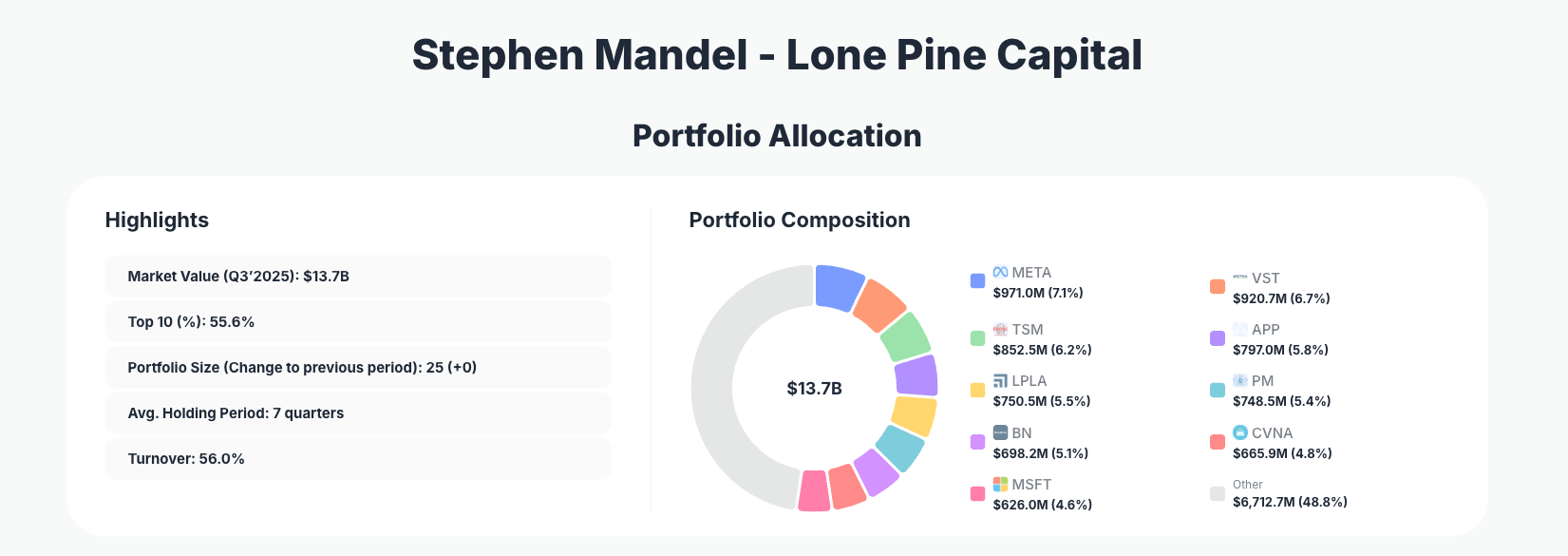
Portfolio Highlights (Q3 2025): - Market Value: $13.7B - Top 10 Holdings: 55.6% of portfolio - Portfolio Size: 25 positions - Average Holding Period: 7 quarters - Turnover: 56.0%
Lone Pine Capital's Q3 2025 positioning reflects a portfolio in transition. With 55.6% of assets concentrated in the top 10 holdings, Mandel maintains a focused approach while demonstrating significant conviction through selective additions and reductions. The 56% turnover rate—notably elevated for a value-oriented manager—underscores the active nature of recent adjustments. This level of portfolio activity suggests Mandel identified meaningful dislocations in valuations, prompting him to reallocate capital toward what he perceives as more attractive risk-reward opportunities.
The portfolio's 7-quarter average holding period indicates Mandel's preference for medium-term positions rather than quick trades, yet his willingness to make substantial adjustments within this timeframe demonstrates flexibility when market conditions warrant repositioning. The fact that Lone Pine's portfolio maintained 25 positions with no net change in position count suggests these moves represent tactical rebalancing rather than a fundamental shift in investment philosophy.
Top Holdings Analysis: The Tale of Two Strategies
The composition of Mandel's current holdings tells a compelling story of selective value hunting. Meta Platforms anchors the portfolio at 7.1%, though Mandel reduced this position by 20.59%—a significant trim that suggests caution regarding valuation despite the social media giant's strong operational performance. Vistra Corp. 6.7% received an even more aggressive 27.37% reduction, indicating Mandel may be taking profits in the energy infrastructure space after substantial gains.
Taiwan Semiconductor Manufacturing Company 6.2% saw a more modest 11.16% reduction, suggesting Mandel maintains conviction in semiconductor exposure while moderating exposure to what may be elevated valuations. Meanwhile, the portfolio reveals aggressive new conviction plays: AppLovin Corporation received a massive 251.44% addition, now representing 5.8% of the portfolio—a dramatic move that signals Mandel sees exceptional value in the mobile marketing platform despite its volatility.
LPL Financial Holdings 5.5% was increased by 20.48%, reflecting confidence in the financial services sector. Philip Morris International 5.4% received a substantial 67.33% boost, indicating Mandel's belief in the tobacco-to-alternatives transition story and the company's dividend-supported valuation. Brookfield Corporation 5.1% was expanded by 81.12%, suggesting Mandel sees compelling opportunities in the diversified infrastructure and real assets space.
The most aggressive addition came in Carvana Co., which received a stunning 360.31% increase to reach 4.8% of the portfolio. This dramatic move into the online used-car retailer suggests Mandel believes the market has overcorrected on the company's turnaround prospects. Meanwhile, Microsoft 4.6% and Amazon 4.5% both experienced substantial reductions of 34.84% and 44.14% respectively, indicating Mandel is rotating away from mega-cap cloud and e-commerce exposure.
What the Portfolio Reveals About Current Strategy
Mandel's Q3 2025 moves illuminate several key strategic themes:
Valuation Discipline Over Growth Momentum: The aggressive trimming of mega-cap technology positions—despite their strong fundamentals—suggests Mandel believes these stocks have become overvalued relative to intrinsic worth. This is classic value investing: selling quality companies when prices become disconnected from fundamentals.
Conviction in Turnaround Narratives: The massive positions in Carvana and AppLovin indicate Mandel sees compelling recovery stories where the market has been overly pessimistic. These aren't contrarian bets for their own sake—they represent calculated positions in businesses with improving unit economics and path-to-profitability.
Infrastructure and Real Assets Appeal: The substantial additions to Brookfield and Philip Morris suggest Mandel is attracted to businesses with stable cash flows, dividend support, and inflation-hedging characteristics—particularly relevant in an uncertain macroeconomic environment.
Selective Semiconductor Exposure: Rather than abandoning the semiconductor space entirely, Mandel maintained TSM as a top-3 holding while moderating the position. This suggests he sees value in the sector but at lower prices than current levels.
Portfolio Concentration Analysis
| Position | Value | % of Portfolio | Recent Change |
|---|---|---|---|
| Meta Platforms, Inc. | $971.0M | 7.1% | Reduce 20.59% |
| Vistra Corp. | $920.7M | 6.7% | Reduce 27.37% |
| Taiwan Semiconductor Manufacturing Company Limited | $852.5M | 6.2% | Reduce 11.16% |
| AppLovin Corporation | $797.0M | 5.8% | Add 251.44% |
| LPL Financial Holdings Inc. | $750.5M | 5.5% | Add 20.48% |
| Philip Morris International Inc. | $748.5M | 5.4% | Add 67.33% |
| Brookfield Corporation | $698.2M | 5.1% | Add 81.12% |
| Carvana Co. | $665.9M | 4.8% | Add 360.31% |
| Microsoft Corporation | $626.0M | 4.6% | Reduce 34.84% |
| Amazon.com, Inc. | $617.4M | 4.5% | Reduce 44.14% |
The concentration metrics reveal a portfolio in flux. The top 10 holdings represent 55.6% of assets, which is moderately concentrated for a 25-position portfolio. What's particularly striking is the divergence in position sizing: the largest position (Meta at 7.1%) is only marginally larger than the eighth-largest (Carvana at 4.8%), suggesting Mandel is building a more balanced portfolio rather than maintaining extreme concentration in his highest-conviction ideas.
The reductions in mega-cap technology positions freed up approximately $2.2 billion in capital, which Mandel deployed across multiple new and expanded positions. This capital reallocation strategy—selling overvalued quality to buy undervalued opportunity—is the hallmark of disciplined value investing. The fact that no positions were eliminated entirely suggests Mandel maintains some exposure to his previous conviction areas while meaningfully rotating toward fresh opportunities.
Most investors waste time on the wrong metrics. We've spent 10,000+ hours perfecting our value investing engine to find what actually matters.
Want to see what we'll uncover next - before everyone else does?
Find Hidden Gems First!
Investment Lessons from Stephen Mandel's Approach
Conviction Requires Flexibility: Mandel's willingness to trim even his largest positions demonstrates that value investing isn't about falling in love with stocks—it's about respecting valuations. When Meta and Microsoft became expensive relative to intrinsic value, he acted decisively.
Turnarounds Deserve Serious Capital: The 251% addition to AppLovin and 360% increase in Carvana show that Mandel doesn't shy away from distressed situations when he identifies genuine value. This requires deep fundamental analysis and conviction in management's ability to execute turnarounds.
Diversification Across Themes: Rather than concentrating all capital in a single sector, Mandel's portfolio spans technology, energy infrastructure, financial services, consumer staples, and real assets. This thematic diversification reduces single-sector risk while maintaining focused positions in high-conviction ideas.
Cash Flow and Dividends Matter: The emphasis on Philip Morris, Brookfield, and LPL Financial—all strong cash-generating businesses—reflects Mandel's preference for companies that can fund growth and shareholder returns from operations rather than relying on multiple expansion.
Valuation Discipline Trumps Narrative: The reduction in mega-cap technology despite their dominance in AI and cloud computing shows Mandel prioritizes intrinsic value calculations over compelling growth stories. This contrarian stance has historically been rewarded when markets eventually reprice overvalued sectors.
Looking Ahead: What Comes Next?
With $13.7 billion deployed across 25 positions and a 56% turnover rate, Mandel has positioned Lone Pine Capital for several potential scenarios. The aggressive moves into turnaround situations suggest he's building positions that could deliver outsized returns if execution improves. The trimming of mega-cap technology creates dry powder for potential additional deployments if market dislocations widen.
The portfolio's current composition suggests Mandel is preparing for an environment where: - Technology valuations face continued pressure as interest rates remain elevated - Infrastructure and real assets benefit from secular demand trends - Distressed businesses with improving fundamentals offer exceptional risk-reward - Dividend-paying stocks provide downside protection in uncertain markets
The 7-quarter average holding period indicates Mandel expects to hold these positions through a full business cycle, suggesting he's not timing short-term market moves but rather positioning for medium-term fundamental improvement. The question for followers of Lone Pine's strategy is whether his conviction in turnarounds like Carvana and AppLovin will be validated by operational improvements, or whether these represent value traps masquerading as opportunities.
FAQ About Stephen Mandel's Portfolio Strategy
Q: Why did Mandel reduce his positions in Meta, Microsoft, and Amazon despite their strong market positions?
A: Mandel's reductions reflect valuation discipline rather than loss of confidence in these companies' businesses. Value investors distinguish between business quality and stock price attractiveness. When quality companies become expensive relative to intrinsic value, disciplined investors trim positions to redeploy capital toward better risk-reward opportunities. The 20-44% reductions suggest Mandel believes these mega-cap tech stocks have become overvalued in the current market environment.
Q: What does the 360% addition to Carvana signal about Mandel's investment thesis?
A: The massive increase in Carvana indicates Mandel believes the market has overcorrected on the company's prospects. He likely sees improving unit economics, a clearer path to profitability, and a valuation that offers exceptional upside if the turnaround succeeds. This is classic contrarian value investing—buying when sentiment is most negative and valuations are most depressed.
Q: How should retail investors interpret the 56% portfolio turnover?
A: The elevated turnover reflects active rebalancing rather than market timing or speculation. Mandel identified meaningful valuation dislocations and acted decisively to capitalize on them. For retail investors following Lone Pine's approach, this demonstrates that value investing isn't passive—it requires constant reassessment of valuations and willingness to make significant portfolio adjustments when opportunities arise.
Q: What's the significance of maintaining 25 positions with no net change in position count?
A: This suggests Mandel's moves represent tactical rebalancing within a consistent strategic framework rather than a fundamental shift in philosophy. He's not abandoning his core approach; he's optimizing it by selling what's become expensive and buying what's become cheap. The stable position count indicates he maintains conviction in his core portfolio structure while adjusting individual holdings.
Q: How can I track Lone Pine Capital's portfolio changes like Mandel does?
A: ValueSense provides real-time tracking of Lone Pine's 13F filings, which are required quarterly disclosures of institutional holdings. These filings are submitted within 45 days of quarter-end, so there's a reporting lag to consider. ValueSense's platform allows you to monitor changes in real-time, compare quarter-over-quarter moves, and analyze the strategic implications of portfolio adjustments. By following superinvestor portfolios through ValueSense, retail investors can gain insights into how professional value investors think about market opportunities and valuation discipline.
Q: Should I copy Mandel's portfolio exactly?
A: While following superinvestor portfolios provides valuable insights, direct replication isn't advisable. Mandel has different tax considerations, different capital availability, different time horizons, and access to information that retail investors lack. Instead, use his portfolio as a learning tool—understand his reasoning, analyze the valuations he's targeting, and apply his principles to your own investment decisions. ValueSense's tools help you conduct the same fundamental analysis Mandel uses to identify undervalued companies.
Explore More Investment Opportunities
For investors seeking undervalued companies with high fundamental quality, our analytics team provides curated stock lists:
📌 50 Undervalued Stocks (Best overall value plays for 2026)
📌 50 Undervalued Dividend Stocks (For income-focused investors)
📌 50 Undervalued Growth Stocks (High-growth potential with strong fundamentals)
🔍 Check out these stocks on the Value Sense platform for free!