The Little Book That Beats the Market by Joel Greenblatt
Welcome to the Value Sense Blog, your resource for insights on the stock market! At Value Sense, we focus on intrinsic value tools and offer stock ideas with undervalued companies. Dive into our research products and learn more about our unique approach at valuesense.io
Explore diverse stock ideas covering technology, healthcare, and commodities sectors. Our insights are crafted to help investors spot opportunities in undervalued growth stocks, enhancing potential returns. Visit us to see evaluations and in-depth market research.
Book Overview
The Little Book That Beats the Market by Joel Greenblatt is a modern classic in value investing literature, offering a simple yet powerful formula for stock selection that has captured the attention of individual investors and professionals alike. Joel Greenblatt, the book’s author, is a respected hedge fund manager, professor at Columbia Business School, and founder of Gotham Capital. His investment track record is legendary: between 1985 and 1994, Greenblatt’s fund reportedly achieved an annualized return of over 40%, cementing his reputation as one of the sharpest minds in finance. His credibility is further enhanced by his academic work and his accessible writing style, which distills complex financial concepts into practical lessons for everyday investors.
The main theme of the book is the concept of buying “good companies at bargain prices.” Greenblatt introduces readers to his “Magic Formula,” a systematic approach based on two key financial metrics: earnings yield and return on capital. Through a blend of storytelling, real-world examples, and humor, Greenblatt demystifies the process of stock selection, making it approachable for readers with little or no financial background. The book’s purpose is to empower investors to achieve market-beating returns by following a disciplined, rules-based strategy that sidesteps the emotional pitfalls that often lead to poor investment decisions. Greenblatt’s conviction is clear: with patience and adherence to simple principles, ordinary investors can outperform Wall Street professionals.
This book is ideal for anyone interested in building long-term wealth through the stock market, from beginners seeking to understand the basics to experienced investors looking for a proven, quantitative edge. Its straightforward language, memorable anecdotes, and actionable advice make it especially valuable for those who have struggled with information overload or the complexity of traditional investment books. Greenblatt’s approach is refreshingly transparent, providing concrete steps and historical evidence to support his claims. He also addresses the psychological challenges investors face, such as impatience and herd mentality, making the book as much about investor behavior as financial analysis.
What sets The Little Book That Beats the Market apart is its blend of simplicity and rigor. Unlike many investment books that either overwhelm with technical jargon or oversimplify the process, Greenblatt strikes a balance by offering a formula that is both easy to understand and backed by decades of empirical data. The book’s structure—using relatable stories (like Jason’s gum business), clear explanations of key concepts, and a step-by-step guide to implementing the Magic Formula—ensures that readers not only grasp the “why” behind the strategy but also the “how.” Greenblatt’s transparency about the formula’s limitations and the behavioral obstacles investors must overcome adds a layer of realism that is often missing from other investment guides.
Ultimately, this book is a must-read for anyone serious about investing. Its lessons have stood the test of time, and its practical framework can be applied by investors of all sizes. Whether you’re managing your own portfolio or simply seeking to understand what drives stock market success, Greenblatt’s insights offer a roadmap to disciplined, value-driven investing that can help you avoid common mistakes and achieve your financial goals.
Key Concepts and Ideas
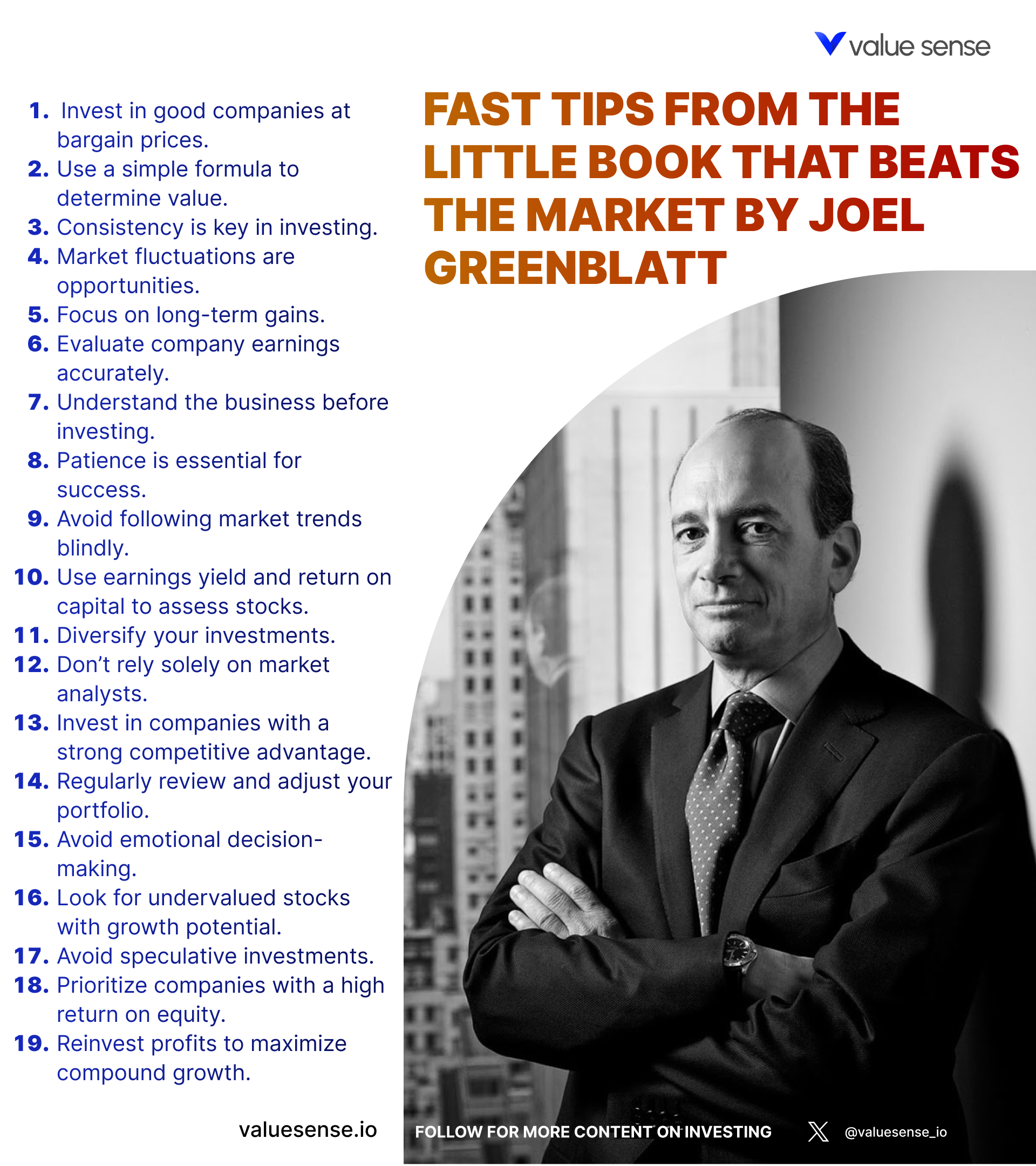
At the heart of The Little Book That Beats the Market is a philosophy rooted in value investing—a discipline made famous by Benjamin Graham and Warren Buffett. Greenblatt adapts these timeless principles for the modern investor, emphasizing that successful investing is not about predicting the next hot stock or timing the market, but about systematically buying excellent businesses at attractive prices. The book’s core message is that a disciplined, rules-based strategy can help investors avoid emotional mistakes and achieve superior long-term returns.
Greenblatt’s investment philosophy is grounded in two fundamental metrics: earnings yield (a measure of how cheap a stock is) and return on capital (a measure of how good a business is). By combining these metrics into what he calls the “Magic Formula,” Greenblatt provides a practical, quantitative framework for stock selection. The book also explores the psychological barriers that prevent most investors from sticking with a winning strategy, highlighting the importance of patience, discipline, and a long-term perspective.
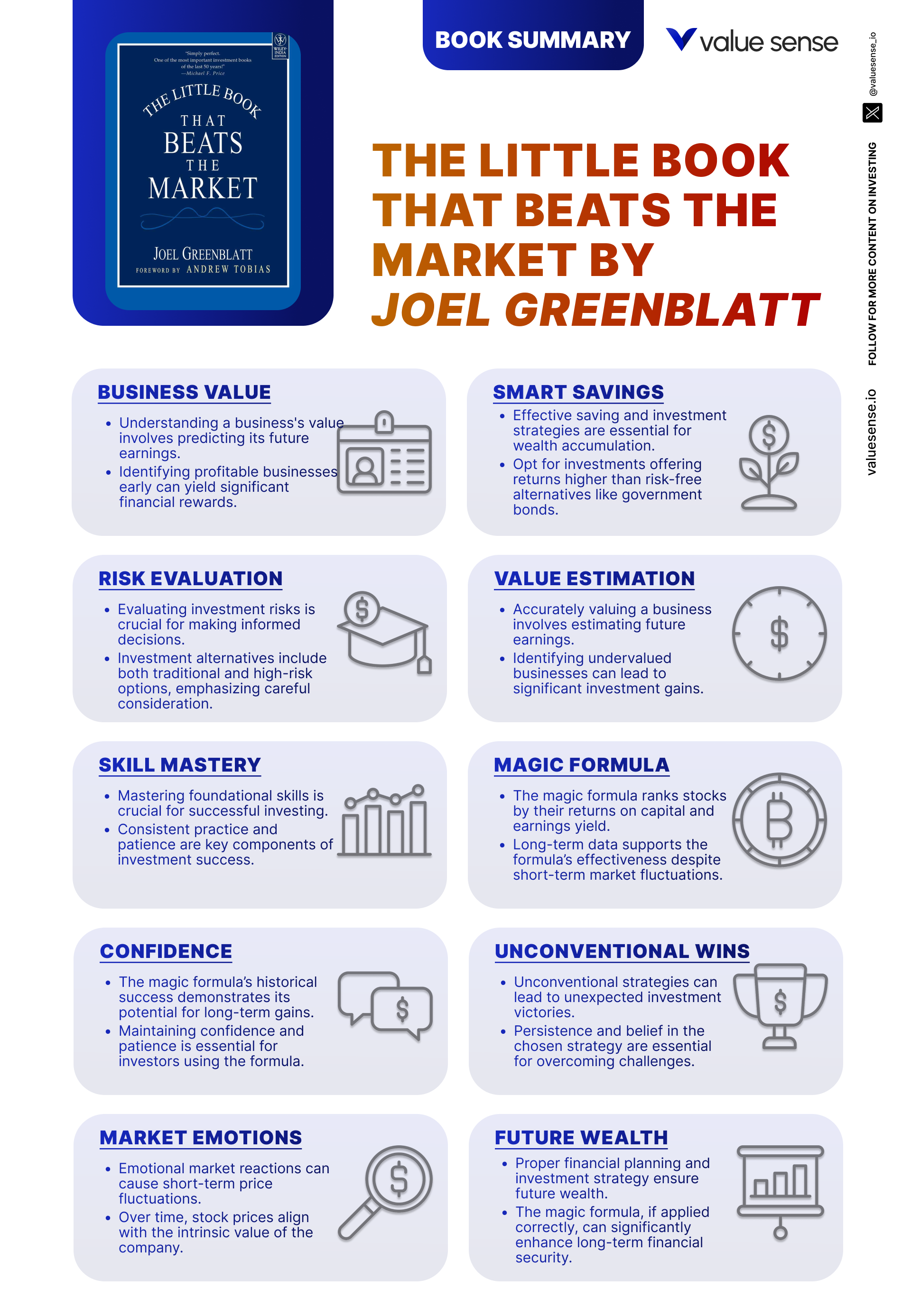
- Business Value Is Driven by Profits: The value of any business is determined by the profits it can generate over time. Greenblatt illustrates this with the story of Jason’s gum business, showing how the price you pay for a business should reflect its expected future earnings. This foundational concept underpins the entire investment process—investors are buying a share of future cash flows, not just a ticker symbol.
- The Power of Compound Interest: Early and consistent investing harnesses the power of compounding, allowing even small amounts to grow exponentially over time. Greenblatt emphasizes that starting early and reinvesting profits can make a dramatic difference in long-term wealth accumulation, a principle echoed by Warren Buffett and other legendary investors.
- Risk and Reward Are Inseparable: Investments that offer higher potential returns generally come with higher risks. The book teaches investors to compare the returns of potential investments against risk-free alternatives like government bonds, ensuring that risks are adequately compensated.
- Intrinsic Value vs. Market Price: Through the metaphor of “Mr. Market,” Greenblatt explains that stock prices often diverge from the true, intrinsic value of a business due to market sentiment and emotion. Wise investors focus on intrinsic value and seek a margin of safety—buying stocks when they are priced below their true worth.
- Earnings Yield and Return on Capital: The Magic Formula is built on these two metrics. Earnings yield (earnings/price) identifies stocks that are cheap relative to their profits, while return on capital (profits/invested capital) identifies companies that efficiently generate profits from their resources. Greenblatt demonstrates that stocks ranking highly on both metrics tend to outperform the market.
- Simplicity Trumps Complexity: Greenblatt argues that successful investing does not require complex models or constant tinkering. Instead, following a simple, consistent strategy—like the Magic Formula—can yield powerful results. The challenge is not in understanding the strategy, but in sticking with it through periods of underperformance.
- Discipline and Patience Are Essential: The biggest obstacle to success is not a lack of knowledge, but a lack of discipline. Greenblatt shows that most investors abandon even the best strategies during tough times, succumbing to impatience or the allure of popular trends. Long-term success requires the conviction to stay the course.
- Diversification Reduces Risk: By applying the Magic Formula to a broad selection of stocks, investors naturally achieve diversification, reducing the impact of any single stock’s poor performance. This systematic approach helps mitigate risk while maintaining the potential for superior returns.
- Behavioral Biases Undermine Results: Greenblatt delves into the psychological traps that cause investors to deviate from sound strategies—such as fear, greed, and the pressure to conform. Recognizing and overcoming these biases is as important as mastering financial analysis.
- Wealth Is a Means, Not an End: In the final chapter, Greenblatt reminds readers that the ultimate goal of investing is not just to accumulate money, but to achieve meaningful financial goals—such as family security, retirement, or personal fulfillment. This perspective encourages investors to focus on what truly matters and to use their wealth wisely.
Practical Strategies for Investors
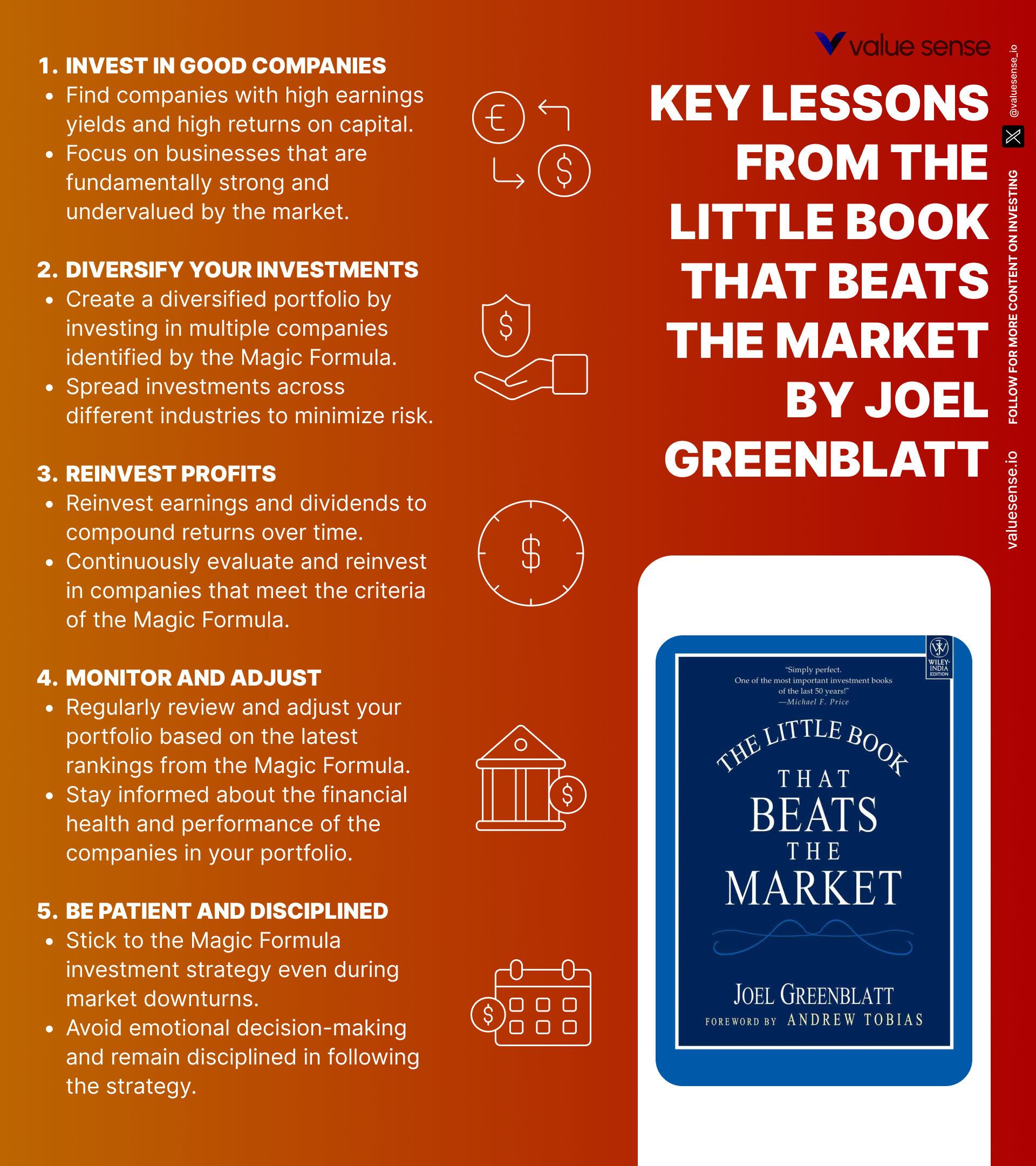
Greenblatt’s book is not just theoretical—it’s packed with actionable strategies that investors can implement immediately. The Magic Formula is designed to be accessible to anyone, regardless of experience or portfolio size. By following a disciplined, rules-based approach, investors can sidestep common mistakes and put themselves on a path to long-term success. Below, we outline the most important practical strategies from the book, along with concrete steps for implementation.
Applying the book’s teachings starts with understanding the metrics that drive the Magic Formula and developing a process for screening, selecting, and managing a portfolio of stocks. Greenblatt provides clear guidelines on how to build and maintain a Magic Formula portfolio, emphasizing the importance of consistency, diversification, and emotional resilience. Investors are encouraged to automate their decision-making as much as possible, reducing the influence of fear and greed.
- Implement the Magic Formula: Screen for stocks with high earnings yield and high return on capital. Each year, rank all eligible stocks (typically those with a market cap above $50 million and excluding financials/utilities) by these two metrics. Select the top 20-30 stocks and invest equally across them, rebalancing annually. Action step: Use online screeners or tools like Value Sense to automate the process.
- Start Early and Invest Consistently: Begin investing as soon as possible to maximize the benefits of compounding. Even small, regular contributions can grow substantially over decades. Action step: Set up automatic monthly investments and reinvest dividends.
- Compare to Risk-Free Alternatives: Before investing, compare the expected return of a stock or portfolio to the yield on risk-free assets like government bonds. Only invest when you are adequately compensated for the additional risk. Action step: Calculate the earnings yield of your portfolio and compare it to the 10-year Treasury yield.
- Focus on Intrinsic Value, Not Market Noise: Ignore short-term market fluctuations and headlines. Instead, concentrate on the underlying value of the businesses you own. Action step: Review company fundamentals quarterly, but avoid reacting to daily price swings.
- Maintain Diversification: Hold a broad portfolio of Magic Formula stocks to reduce the impact of individual company failures. Action step: Invest in at least 20-30 stocks across different sectors each year.
- Stick with the Strategy Through Thick and Thin: Resist the urge to abandon the Magic Formula during periods of underperformance. Greenblatt’s research shows that the strategy works over the long term, but may lag the market for months or even years. Action step: Commit to following the strategy for at least 5-10 years.
- Rebalance Annually: Once a year, sell stocks that no longer meet the criteria and replace them with new top-ranked stocks. This systematic rebalancing ensures that your portfolio remains aligned with the Magic Formula. Action step: Set a calendar reminder to review and rebalance your portfolio each year.
- Be Aware of Behavioral Biases: Recognize the psychological traps that can lead you astray—such as chasing trends, panicking during downturns, or abandoning the strategy prematurely. Action step: Keep a written investment plan and review it when tempted to deviate from your process.

Most investors waste time on the wrong metrics. We've spent 10,000+ hours perfecting our value investing engine to find what actually matters.
Want to see what we'll uncover next - before everyone else does?
Find Hidden Gems First!
Chapter-by-Chapter Insights
The Little Book That Beats the Market is structured as a step-by-step guide to value investing, with each chapter building on the previous one. Greenblatt uses a combination of simple stories, practical examples, and clear explanations to introduce readers to key investment concepts. The book’s chapters follow a logical progression, starting with the basics of business valuation and ending with the psychological and philosophical aspects of wealth building. Each chapter contains actionable lessons, illustrated by memorable anecdotes and real-world data.
Below, we provide a detailed, chapter-by-chapter analysis, drawing out the main ideas, specific examples, and practical applications for investors. Each chapter is explored in depth to ensure that readers can extract the maximum value from Greenblatt’s teachings. Whether you’re new to investing or looking to refine your approach, these insights offer a comprehensive roadmap to disciplined, long-term success.
Chapter 1: Jason’s Business and the Value of Money
The opening chapter sets the stage by introducing Jason, a young boy who starts a gum-selling business. Greenblatt uses this relatable example to explain the core concept of business valuation: the value of any business is determined by the profits it can generate over time. Jason’s business, with its simple revenues and costs, provides a tangible illustration of how to calculate profits and assess what a business is really worth. The story demystifies the stock market by showing that buying a stock is essentially buying a share of a real business, not just a ticker symbol.
Greenblatt further explains that the price you pay for a business should reflect the profits you expect it to generate. For instance, if Jason’s gum business earns $1,000 a year and you can buy it for $5,000, you’re paying five times earnings—a concept directly analogous to the price-to-earnings (P/E) ratio in the stock market. The chapter includes simple math to show how different purchase prices affect your return on investment. Greenblatt emphasizes that higher expected returns generally come with higher risks, and that investors must weigh potential rewards against the risks involved.
For investors, this chapter offers a practical framework for evaluating any investment: focus on the underlying business and its ability to generate profits, not on short-term market movements. Greenblatt advises readers to think like business owners, considering whether the price they pay is justified by the business’s earning power. He encourages patience and a long-term perspective, warning against being swayed by daily price fluctuations or market noise.
Historically, this business-owner mindset has been championed by value investing legends like Warren Buffett and Benjamin Graham. By starting the book with a simple, real-world example, Greenblatt makes the concept accessible to all readers. In today’s market, where speculation and hype often drive prices, this foundational lesson is more relevant than ever. Investors who focus on business fundamentals are better equipped to avoid bubbles and make rational, profitable decisions.
Chapter 2: The Importance of Saving and Investing Wisely
In the second chapter, Greenblatt shifts focus to the importance of saving and the power of investing wisely. He explains that while saving money is crucial, it’s not enough to build meaningful wealth—money must be invested so that it grows over time. The chapter introduces the concept of compound interest, showing how investments can grow exponentially when returns are reinvested over many years. Greenblatt uses simple math and examples to illustrate how starting early and investing consistently can lead to significant wealth accumulation.
For example, Greenblatt demonstrates that investing $1,000 per year at a 10% annual return grows to over $100,000 in 25 years, thanks to compounding. He stresses that the sooner you start, the more powerful compounding becomes—waiting just a few years can dramatically reduce your ultimate wealth. The chapter also covers the relationship between risk and reward, noting that higher returns typically come with higher risks. Greenblatt encourages readers to balance their investment portfolios to manage risk while aiming for growth.
The actionable takeaway for investors is clear: start investing as early as possible, and maintain the discipline to save and invest regularly. Greenblatt suggests setting up automatic investment plans to ensure consistency. He also warns against the temptation to spend rather than invest, emphasizing the long-term benefits of financial discipline. The chapter provides a compelling argument for making investing a lifelong habit, rather than a sporadic activity.
Historically, the principle of compounding has been the cornerstone of wealth creation for investors like Warren Buffett, who famously called it the “eighth wonder of the world.” In today’s environment, with low interest rates and volatile markets, the importance of starting early and investing consistently is more critical than ever. Greenblatt’s clear explanations and practical examples make this chapter a valuable resource for investors of all ages.
Chapter 3: Evaluating Business Worth
This chapter delves into the mechanics of evaluating a business’s worth, building on the foundation laid in the earlier chapters. Greenblatt uses Jason’s gum business as a case study to introduce readers to financial statements, particularly the income statement. He explains how to analyze revenues, costs, and profits to determine whether a business is making money or losing it. The chapter also introduces the concept of benchmarking investment returns against risk-free alternatives, such as government bonds, to assess whether an investment is worthwhile.
Greenblatt provides specific examples of how to read an income statement and calculate profitability. He shows that simply looking at a company’s current earnings isn’t enough—investors must consider the business’s potential to generate profits in the future. The chapter includes comparisons between investing in Jason’s business and buying a risk-free government bond, highlighting the need to be compensated for taking on additional risk. Greenblatt emphasizes that the value of a business is tied not just to its present earnings, but to its ability to sustain and grow those earnings over time.
For practical application, Greenblatt advises investors to analyze financial statements before making any investment decision. He suggests comparing the expected return on an investment to the yield on government bonds, ensuring that the additional risk is justified. Investors should also look beyond short-term profits and consider the long-term sustainability of the business. This disciplined approach helps avoid overpaying for companies with uncertain futures.
In the real world, this analytical framework is used by professional investors and analysts to separate attractive opportunities from risky bets. During the dot-com bubble of the late 1990s, many investors ignored fundamentals and paid the price when profits failed to materialize. By focusing on financial statements and risk-adjusted returns, investors can avoid similar mistakes and make more informed decisions in any market environment.
Chapter 4: The Stock Market and Mr. Market
Chapter four introduces the famous “Mr. Market” metaphor, originally conceived by Benjamin Graham. Greenblatt uses this character to illustrate the stock market’s volatility and irrationality. Mr. Market offers to buy or sell stocks at wildly fluctuating prices, driven by his emotional swings rather than rational analysis. Greenblatt explains that these price movements often have little to do with the underlying value of the business, creating opportunities for disciplined investors to buy low and sell high.
The chapter highlights the difference between market price and intrinsic value. Greenblatt argues that wise investors focus on the true worth of a business, as determined by its financial health and future earning potential, rather than being swayed by daily price changes. He introduces the concept of a “margin of safety”—buying stocks at a significant discount to their intrinsic value to protect against errors in judgment or unforeseen events. This approach reduces the risk of permanent capital loss and increases the likelihood of long-term success.
For investors, the lesson is to ignore short-term market noise and concentrate on intrinsic value. Greenblatt suggests using periods of market pessimism to buy quality stocks at bargain prices, while avoiding the temptation to chase hot trends during booms. He emphasizes the importance of patience, discipline, and rational analysis in navigating the emotional swings of Mr. Market.
Historically, the Mr. Market metaphor has guided some of the most successful investors, including Warren Buffett, who famously said, “In the short run, the market is a voting machine, but in the long run, it is a weighing machine.” In times of market turmoil—such as the 2008 financial crisis or the COVID-19 pandemic—investors who focused on intrinsic value and maintained a margin of safety often emerged with superior results. Greenblatt’s advice is timeless, offering a reliable framework for navigating both bull and bear markets.
Chapter 5: Simple Concepts, Powerful Results
In this pivotal chapter, Greenblatt stresses that successful investing does not require complex strategies or advanced mathematics. Instead, he advocates for the consistent application of simple, proven principles—specifically, the use of earnings yield and return on capital as core metrics for stock selection. Greenblatt explains that earnings yield (earnings/price) helps investors identify companies that are undervalued relative to their profits, while return on capital (profits/invested capital) measures how efficiently a company uses its resources to generate returns.
Greenblatt provides concrete examples of how these metrics can be used to compare companies and select those with the best combination of value and quality. He argues that higher earnings yields indicate better value for investors, while higher returns on capital signal superior business performance. The chapter includes historical data showing that stocks ranking highly on both metrics have consistently outperformed the broader market over long periods. Greenblatt cautions against getting lost in complex analyses or chasing the latest investment fads.
For practical implementation, Greenblatt recommends focusing on a handful of key metrics—earnings yield and return on capital—rather than trying to analyze every possible variable. He advises investors to apply these metrics consistently, building a portfolio of stocks that meet both criteria. This disciplined approach reduces the likelihood of emotional decision-making and increases the probability of achieving superior returns.
Historically, the power of simple, rules-based investing has been demonstrated by numerous academic studies and real-world results. The Magic Formula’s success in different market environments—documented in Greenblatt’s own research—underscores the value of sticking to basic principles. In an era where financial markets are increasingly complex and information is abundant, Greenblatt’s emphasis on simplicity is a refreshing reminder that less can be more.
---
Explore More Investment Opportunities

For investors seeking undervalued companies with high fundamental quality, our analytics team provides curated stock lists:
📌 50 Undervalued Stocks (Best) overall value plays for 2025
📌 50 Undervalued Dividend Stocks (For income-focused investors)
📌 50 Undervalued Growth Stocks (High-growth potential with strong fundamentals)
🔍 Check out these stocks on the Value Sense platform for free!
---
Chapter 6: The Magic Formula and Its Results
This chapter is the heart of the book, where Greenblatt unveils the Magic Formula and presents the evidence for its effectiveness. The Magic Formula combines the two metrics discussed earlier—earnings yield and return on capital—into a systematic process for selecting stocks. Greenblatt describes how, each year, investors can rank all eligible stocks by these metrics, select the top 20-30, and invest equally across them. He provides historical data showing that this approach has significantly outperformed the S&P 500 over multi-decade periods, with annualized returns exceeding 20% in some studies.
Greenblatt is careful to note that the Magic Formula does not work every year—there are periods when it underperforms the market, sometimes for several years in a row. However, over the long term, the strategy has delivered superior results. He attributes its success to the systematic avoidance of overpriced, low-quality stocks and the disciplined focus on undervalued, high-quality businesses. The chapter includes charts, tables, and case studies to illustrate the formula’s performance across different market cycles.
For investors, the takeaway is to trust the process and maintain a long-term perspective. Greenblatt advises against abandoning the strategy during periods of underperformance, as this is when most investors are tempted to quit. He encourages readers to stick with the formula for at least 5-10 years to realize its full potential. The chapter also addresses practical considerations, such as portfolio size, transaction costs, and the importance of rebalancing annually.
Historically, quantitative strategies like the Magic Formula have gained popularity among institutional investors, but Greenblatt’s contribution is making such an approach accessible to individuals. In today’s market, where algorithmic trading and information overload are common, the Magic Formula offers a straightforward, evidence-based path to superior returns. By following Greenblatt’s guidelines, investors can harness the power of systematic investing without needing advanced technical skills.
Chapter 7: Can It Continue to Work?
In this chapter, Greenblatt addresses a critical question: Will the Magic Formula continue to work in the future? He acknowledges that while the formula’s past performance is impressive, there is always a risk that widespread adoption could erode its effectiveness. Greenblatt argues, however, that the underlying principles of the Magic Formula—buying good companies at bargain prices—are timeless and unlikely to be arbitraged away completely. He points to the enduring success of value investing and the persistent presence of behavioral biases in markets as evidence for the strategy’s continued relevance.
Greenblatt presents data showing that the Magic Formula has been tested across a wide range of market conditions, including bull and bear markets, economic booms and recessions. In each case, the strategy has shown resilience and robustness, outperforming the market over long periods. He also discusses the importance of discipline, noting that the formula’s success depends on consistent application, even when it is temporarily out of favor. Greenblatt reassures readers that skepticism is healthy, but should be balanced against the strong historical track record of the strategy.
For investors, the lesson is to understand the logic behind the Magic Formula and to remain committed to it through market cycles. Greenblatt suggests that those who truly grasp the rationale for the strategy are less likely to abandon it during tough times. He also encourages readers to set realistic expectations, recognizing that no strategy works all the time. By focusing on long-term results and avoiding the temptation to chase short-term performance, investors can maximize their chances of success.
Historically, many investment strategies have lost effectiveness as they became widely known, but value investing principles have persisted for decades. The Magic Formula’s reliance on fundamental metrics and behavioral inefficiencies suggests that it will remain effective as long as markets are driven by human emotion. In the current environment, where passive investing and index funds dominate, disciplined value strategies like the Magic Formula offer a compelling alternative for those seeking to outperform.
Chapter 8: Why Most People Won't Follow the Formula
This chapter explores the psychological and behavioral reasons why most investors fail to stick with the Magic Formula, despite its proven success. Greenblatt identifies several key obstacles: impatience, fear of missing out on popular trends, and the pressure to conform to the crowd. He explains that during periods of underperformance, many investors lose confidence in the strategy and abandon it just before it rebounds. The chapter draws on behavioral finance research to illustrate how emotions and cognitive biases can undermine rational decision-making.
Greenblatt provides examples of common investor mistakes, such as chasing hot stocks during bull markets or panicking and selling during downturns. He argues that the biggest challenge is not understanding the strategy, but maintaining the discipline to follow it consistently over the long term. The chapter includes anecdotes and case studies of investors who succeeded by sticking with the formula, as well as those who failed by giving up too soon. Greenblatt emphasizes the importance of conviction in the underlying logic of the strategy.
For practical application, Greenblatt advises investors to develop a written investment plan and to review it regularly, especially during periods of market stress. He suggests setting clear rules for when to buy and sell, and automating as much of the process as possible to reduce the influence of emotion. The chapter also recommends seeking out supportive communities or mentors who share a commitment to disciplined investing.
Historically, the failure to stick with sound strategies is a major reason why individual investors underperform the market. Studies have shown that the average investor’s returns lag far behind those of the strategies they attempt to follow, primarily due to poor timing and emotional decision-making. Greenblatt’s insights are particularly relevant in today’s fast-paced, information-rich environment, where the temptation to deviate from a disciplined approach is ever-present. By understanding and overcoming these behavioral obstacles, investors can greatly improve their long-term results.
Chapter 9: Vomit Under the 3em-Spaces and Run!
In this uniquely titled chapter, Greenblatt uses an anecdote from his school days to drive home the importance of sticking to proven principles, even when they seem outdated or unpopular. The story serves as a metaphor for the enduring relevance of the Magic Formula. Greenblatt argues that, like basic arithmetic, the principles underlying the Magic Formula are timeless and should not be abandoned in favor of more complex or trendy strategies. He cautions against being distracted by market noise or the latest investment fads.
Greenblatt recounts how, in school, he was tempted to deviate from established methods in pursuit of shortcuts or new approaches, only to discover that the basics worked best. He draws a parallel to investing, where the allure of new strategies often leads investors astray. The chapter includes examples of market trends—such as the dot-com bubble and the rise of speculative assets—that captured the public’s imagination but ultimately resulted in significant losses for those who abandoned sound principles.
For investors, the lesson is to maintain confidence in the underlying logic of the Magic Formula, even when it is out of favor. Greenblatt suggests that the market is full of distractions and that success comes from focusing on what works over the long term. He encourages readers to resist the temptation to follow the crowd and to stay the course, even when others are abandoning the strategy.
Historically, investors who have stuck with value investing principles through cycles of boom and bust have been rewarded with superior returns. The Magic Formula’s reliance on fundamental metrics ensures that it remains relevant, regardless of market trends. In today’s environment, where new investment products and strategies are constantly being introduced, Greenblatt’s emphasis on timeless principles is a valuable antidote to the noise and hype that often dominate financial media.
Chapter 10: The Magic Formula: It’s All About the Math
In this chapter, Greenblatt dives deeper into the mathematical reasoning behind the Magic Formula’s success. He explains that the formula’s focus on high earnings yield and high return on capital is not arbitrary—it is grounded in solid financial principles. Greenblatt provides data showing that companies with these characteristics are both undervalued and profitable, making them attractive investments. The chapter includes charts and tables demonstrating the formula’s consistent outperformance of the market over long periods.
Greenblatt reassures readers that while the formula may not work every year, its long-term effectiveness has been proven time and again. He emphasizes the importance of patience and the willingness to endure short-term underperformance in pursuit of superior long-term results. The chapter also addresses the psychological challenges of sticking with the strategy, noting that understanding the math behind it can help investors maintain confidence during tough times.
For practical application, Greenblatt advises investors to trust in the process and to focus on the long-term track record of the strategy. He suggests reviewing historical data to reinforce conviction and to avoid making changes based on short-term results. The chapter also provides guidance on how to implement the Magic Formula using online tools and resources, making it accessible to investors of all experience levels.
Historically, quantitative strategies like the Magic Formula have delivered strong results for those who stick with them. In the current market, where volatility and uncertainty are common, the discipline of a rules-based approach is especially valuable. Greenblatt’s clear explanations and supporting data make this chapter a compelling argument for systematic investing, regardless of market conditions.
Chapter 11: Why the Magic Formula Works
This chapter explores the reasons behind the Magic Formula’s consistent outperformance. Greenblatt explains that the formula works by exploiting the irrational behaviors of other market participants, who often overlook or undervalue good companies. By systematically focusing on companies that are both good (high return on capital) and cheap (high earnings yield), the formula avoids common traps such as overpaying for popular stocks or chasing performance.
Greenblatt discusses the importance of diversification, noting that the Magic Formula naturally leads to a portfolio of high-quality, undervalued stocks across different sectors. This diversification reduces risk while maintaining the potential for superior returns. The chapter includes examples of how the formula has helped investors avoid major losses during market downturns by steering them away from overpriced, speculative assets.
For investors, the key lesson is to focus on value and profitability, rather than market sentiment or short-term trends. Greenblatt suggests that the systematic approach of the Magic Formula minimizes emotional decision-making and helps investors stay disciplined. He also emphasizes the importance of patience and long-term thinking, as the formula’s success depends on sticking with it through market cycles.
Historically, the Magic Formula’s performance has been supported by academic research and real-world results. In periods of market turbulence—such as the 2008 financial crisis—portfolios constructed using the formula experienced smaller drawdowns and faster recoveries than the broader market. Greenblatt’s insights are particularly relevant in today’s environment, where behavioral biases and herd mentality often lead to suboptimal investment decisions.
Chapter 12: Why Most People Won’t Use It
In this chapter, Greenblatt revisits the psychological barriers that prevent most investors from using the Magic Formula consistently. He explains that impatience, short-term focus, and the fear of missing out on other opportunities are the primary reasons why investors abandon the strategy. Greenblatt emphasizes that the biggest challenge is not understanding the formula, but maintaining the discipline to follow it through periods of underperformance or market volatility.
Greenblatt provides examples of investors who started with the Magic Formula but gave up after a year or two of disappointing results, only to miss out on the strong returns that followed. He argues that those who can overcome short-term doubts and stick with the strategy are likely to reap significant long-term rewards. The chapter includes practical advice for developing the mental resilience needed to stay the course, such as setting clear goals, reviewing historical data, and seeking support from like-minded investors.
For practical application, Greenblatt suggests creating a written investment plan that outlines the rules of the strategy and the reasons for following it. He recommends reviewing this plan regularly, especially during periods of market stress, to reinforce conviction and avoid emotional decision-making. The chapter also advises automating as much of the process as possible to reduce the temptation to deviate from the strategy.
Historically, the failure to maintain discipline is a major reason why individual investors underperform the market. Studies have shown that the average investor’s returns lag significantly behind those of the strategies they attempt to follow, primarily due to poor timing and emotional reactions. Greenblatt’s insights are especially relevant in today’s fast-paced, information-rich environment, where the temptation to abandon a disciplined approach is ever-present. By understanding and overcoming these psychological barriers, investors can greatly improve their long-term results.
Chapter 13: What If You Had a Lot of Money?
The final chapter encourages readers to reflect on the purpose of wealth and the importance of setting meaningful financial goals. Greenblatt suggests that the ultimate value of the Magic Formula is not just the money it can generate, but the financial freedom and security it can provide. He emphasizes that wealth should be used to achieve personal and family security, retirement, and other life goals, rather than simply accumulating more money for its own sake.
Greenblatt shares personal anecdotes and examples of investors who used their wealth to enhance their lives and the lives of their loved ones. He encourages readers to think about what financial success means to them personally, and to use their investments as a tool to achieve those goals. The chapter includes practical advice on setting financial objectives, planning for retirement, and ensuring that wealth is used wisely and effectively.
For investors, the key takeaway is to maintain a long-term perspective and to focus on what truly matters. Greenblatt advises against getting caught up in the pursuit of ever-higher returns or the latest investment trends. Instead, he suggests using the Magic Formula as a means to an end—a way to achieve financial security and peace of mind. The chapter serves as a reminder that investing is ultimately about improving quality of life, not just growing a bank account.
Historically, the most successful investors have been those who set clear goals and used their wealth to achieve them. In today’s world, where financial pressures and distractions are abundant, Greenblatt’s emphasis on purposeful wealth is a valuable reminder. By focusing on long-term objectives and using disciplined strategies like the Magic Formula, investors can build lasting financial security and achieve the freedom to pursue their dreams.
Advanced Strategies from the Book
While the Magic Formula is designed to be simple and accessible, Greenblatt also discusses several advanced techniques that can further enhance investment results for those willing to dig deeper. These strategies build on the core principles of value investing, adding layers of nuance and customization for investors seeking to optimize their portfolios. Below, we outline some of the most powerful advanced techniques from the book, complete with examples and implementation tips.
Greenblatt’s advanced strategies focus on refining the stock selection process, managing risk, and adapting the Magic Formula to different market environments. By incorporating these techniques, investors can tailor the approach to their individual goals, risk tolerance, and time horizon. The following sections detail each strategy and provide practical guidance for putting them into action.
Strategy 1: Adjusting for Industry Differences
The Magic Formula works best when applied to companies in industries where earnings and return on capital are meaningful and comparable. However, Greenblatt notes that certain sectors—such as financials and utilities—have unique accounting practices that can distort these metrics. To address this, advanced investors can exclude these sectors from their screening process or adjust the metrics to better reflect economic reality. For example, in technology or healthcare, where intangible assets are significant, investors might adjust capital calculations to include R&D expenses or intellectual property. By tailoring the formula to industry specifics, investors can improve the accuracy of their stock selection and avoid misleading signals.
Strategy 2: Incorporating Quality Screens
Beyond earnings yield and return on capital, Greenblatt suggests adding additional quality screens to filter out companies with questionable financial health or governance. This might include screening for strong balance sheets, low debt-to-equity ratios, or consistent free cash flow generation. For instance, investors could require that Magic Formula stocks also have a current ratio above 1.5 or a debt-to-equity ratio below 0.5. By adding these extra layers of scrutiny, investors can reduce the risk of value traps—stocks that appear cheap but are fundamentally flawed. This approach is particularly valuable during economic downturns, when financially weak companies are more likely to fail.
Strategy 3: Tax-Efficient Portfolio Management
Greenblatt discusses the importance of managing taxes when implementing the Magic Formula, especially for investors in taxable accounts. One advanced technique is to harvest tax losses by selling losing positions before year-end, offsetting gains from winning stocks. Another is to hold positions for at least one year to qualify for lower long-term capital gains tax rates. By strategically timing sales and purchases, investors can enhance after-tax returns without deviating from the core principles of the Magic Formula. Greenblatt recommends consulting with a tax advisor to optimize these strategies based on individual circumstances.
Strategy 4: Dynamic Rebalancing Based on Market Conditions
While the standard Magic Formula calls for annual rebalancing, advanced investors may choose to adjust the timing or frequency based on market volatility or personal circumstances. For example, during periods of extreme market stress (such as the 2008 financial crisis or the COVID-19 crash), investors might rebalance more frequently to take advantage of sharp price dislocations. Conversely, in stable markets, less frequent rebalancing can reduce transaction costs and taxes. Greenblatt emphasizes that any adjustments should be systematic and rules-based, rather than driven by emotion or market timing.
Strategy 5: Combining with Other Value Strategies
Some advanced investors may choose to combine the Magic Formula with other proven value strategies, such as dividend growth investing or deep value screens (e.g., low price-to-book or price-to-sales ratios). For example, an investor might require that Magic Formula stocks also have a 10-year history of dividend increases, or that they trade at a discount to tangible book value. By blending multiple value approaches, investors can further diversify their portfolios and potentially enhance returns. Greenblatt cautions, however, that any additional screens should be grounded in sound financial logic and supported by historical evidence.
Most investors waste time on the wrong metrics. We've spent 10,000+ hours perfecting our value investing engine to find what actually matters.
Want to see what we'll uncover next - before everyone else does?
Find Hidden Gems First!
Implementation Guide
Getting started with the Magic Formula is straightforward, but long-term success requires discipline and a systematic approach. Greenblatt provides a clear roadmap for implementing his strategy, from stock selection to portfolio management. The following guide outlines the key steps investors should take to put the Magic Formula into action and maximize their chances of achieving superior returns.
First, investors should familiarize themselves with the core metrics—earnings yield and return on capital—and understand how to calculate them. Next, they should develop a process for screening and ranking stocks, either manually or using online tools like Value Sense. Finally, investors must commit to following the strategy consistently, rebalancing annually and resisting the urge to deviate based on short-term performance. The following steps provide a concrete framework for implementation:
- Start by learning how to calculate earnings yield and return on capital for a wide range of stocks.
- Use a stock screener or investment tool to rank all eligible stocks by these metrics, excluding financials and utilities.
- Select the top 20-30 stocks each year and invest equally across them, ensuring diversification across sectors.
- Set a calendar reminder to rebalance your portfolio annually, selling stocks that no longer meet the criteria and replacing them with new top-ranked stocks.
- Monitor your portfolio quarterly, but avoid reacting to daily price swings or market noise—focus on the long-term performance of the strategy.
- Keep a written investment plan outlining your rules and reasons for following the Magic Formula, and review it regularly to reinforce discipline.
- Consider tax implications and transaction costs, especially if investing in a taxable account—harvest losses and hold positions for at least one year when possible.

Critical Analysis
The Little Book That Beats the Market excels at distilling complex investment concepts into an accessible, actionable framework. Greenblatt’s writing is engaging and clear, making the book suitable for both beginners and experienced investors. The use of simple stories, practical examples, and supporting data helps demystify the stock selection process and empowers readers to take control of their financial futures. The Magic Formula’s track record of outperformance, combined with its ease of implementation, makes it one of the most compelling quantitative strategies available to individual investors.
However, the book is not without its limitations. The Magic Formula is best suited to U.S. stocks and may not translate directly to international markets or certain sectors (such as financials and utilities). The strategy also requires patience and discipline, as periods of underperformance can test even the most committed investors. Transaction costs and tax implications may reduce returns for smaller portfolios or those in taxable accounts. Additionally, while the formula has worked well historically, there is no guarantee that it will continue to outperform in the future, especially if it becomes too widely adopted.
In the current market environment—characterized by low interest rates, high valuations, and increased competition from passive investing—the Magic Formula remains a valuable tool for disciplined investors seeking an edge. Its focus on fundamental value and profitability provides a counterbalance to the speculative excesses that often dominate financial markets. By combining simplicity, rigor, and behavioral insights, Greenblatt’s book offers a timeless roadmap to investment success, while also acknowledging the challenges and limitations inherent in any strategy.
Conclusion
The Little Book That Beats the Market is a masterclass in value investing, offering a simple yet powerful formula for achieving superior returns. Joel Greenblatt’s clear explanations, practical examples, and evidence-based approach make the book an essential resource for anyone serious about building long-term wealth. The Magic Formula’s reliance on fundamental metrics and systematic discipline provides a robust framework for navigating the complexities of the stock market.
The book’s greatest strength lies in its accessibility—Greenblatt makes sophisticated concepts understandable without sacrificing rigor. By addressing both the financial and psychological aspects of investing, the book equips readers with the tools and mindset needed to succeed. While no strategy is foolproof, the Magic Formula’s consistent track record and logical foundation make it a valuable addition to any investor’s toolkit.
For those willing to commit to a disciplined, long-term approach, The Little Book That Beats the Market offers a proven path to financial freedom. Its lessons are as relevant today as when the book was first published, and its practical guidance can help investors avoid common mistakes and achieve their most important financial goals.
--- ---
10+ Free intrinsic value tools

For investors looking to find a stock's fair value, our analytics team has you covered with intrinsic value tools:
📍 Free Intrinsic Value Calculator
📍 Reverse DCF & DCF value tools
📍 Peter Lynch Fair Value Calculator
📍 Ben Graham Fair Value Calculator
📍 Relative Value tool
...and plenty more.
🔍 Explore all these tools for free on the Value Sense platform and start discovering what your favorite stocks are really worth.
FAQ: Common Questions About The Little Book That Beats the Market
1. What is the Magic Formula described in the book?
The Magic Formula is Joel Greenblatt’s systematic investment strategy that ranks stocks based on two key metrics: high earnings yield (earnings/price) and high return on capital (profits/invested capital). By selecting and investing equally in the top 20-30 stocks each year that score best on these metrics, the formula aims to buy good companies at bargain prices, leading to superior long-term returns.
2. Who should read The Little Book That Beats the Market?
This book is ideal for both beginner and experienced investors who want a simple, rules-based approach to stock selection. It’s especially valuable for those interested in value investing, systematic strategies, or anyone looking to avoid emotional decision-making and improve their long-term investment results.
3. Does the Magic Formula work in all market conditions?
The Magic Formula has historically outperformed the market over long periods, but it does not work every year. There can be stretches—sometimes several years—when the strategy underperforms. Greenblatt emphasizes the importance of patience and discipline, noting that long-term adherence is key to realizing the strategy’s full potential.
4. Are there any limitations to using the Magic Formula?
Yes, the Magic Formula works best with U.S. stocks and may not be directly applicable to financials, utilities, or international markets due to accounting differences. Transaction costs and taxes can also impact returns, especially for smaller portfolios. The strategy requires discipline to stick with it during periods of underperformance.
5. How can I implement the Magic Formula in my own portfolio?
Start by screening for stocks with high earnings yield and high return on capital, excluding financials and utilities. Rank all eligible stocks, select the top 20-30, and invest equally across them. Rebalance annually and resist the urge to abandon the strategy during tough periods. Tools like Value Sense can help automate this process.
6. What psychological challenges do investors face with this strategy?
Many investors struggle with impatience, fear of missing out, and the pressure to conform to popular trends. The biggest challenge is maintaining discipline and sticking with the formula through periods of underperformance. Greenblatt recommends having a written investment plan and reviewing it regularly to reinforce conviction.
7. Can the Magic Formula be combined with other investment strategies?
Yes, advanced investors may choose to add quality screens (such as low debt or consistent free cash flow), blend with other value strategies (like dividend growth), or adjust for industry differences. However, any additional criteria should be based on sound financial logic and historical evidence to avoid diluting the formula’s effectiveness.
8. What are some real-world examples of the Magic Formula’s success?
Greenblatt’s own hedge fund, Gotham Capital, achieved over 40% annualized returns in its early years using similar principles. Academic studies and backtests have shown that portfolios constructed using the Magic Formula have outperformed the S&P 500 by several percentage points annually over multi-decade periods, though results vary by market cycle.
9. How important is diversification in the Magic Formula approach?
Diversification is a key component of the Magic Formula. By investing in 20-30 stocks across different sectors, investors reduce the risk of any single company’s poor performance impacting overall returns. This broad approach helps smooth out volatility and enhances the strategy’s resilience.
10. What is the ultimate goal of following the Magic Formula?
The ultimate goal is to achieve long-term financial security and freedom by systematically investing in high-quality, undervalued businesses. Greenblatt emphasizes that wealth should be used to achieve meaningful life goals, such as family security and retirement, rather than simply accumulating money for its own sake.