You Can Be a Stock Market Genius by Joel Greenblatt

Welcome to the Value Sense Blog, your resource for insights on the stock market! You're reading a book review written by the valuesense.io team.
On our platform, you'll find stock research and insights across all sectors. Dive into our research products and learn more about our unique approach at valuesense.io
We offer over 360+ automated stock ideas, a free AI-powered stock screener, interactive stock charting tools, and more than 10 intrinsic value models — all designed to help investors find undervalued growth opportunities.
Book Overview
"You Can Be a Stock Market Genius," authored by Joel Greenblatt, stands as a classic in the realm of value investing literature. Greenblatt, a Columbia Business School adjunct professor and the founder of Gotham Capital, is renowned for his exceptional track record—Gotham Capital reportedly achieved annualized returns of 40% from 1985 to 1994. His credentials as both a practitioner and an educator lend significant authority to the book, which is often cited alongside the works of Warren Buffett and Benjamin Graham. Greenblatt’s unique ability to distill complex investment concepts into actionable strategies makes his writing accessible to both novice and experienced investors.
The book was published in 1997, a period marked by robust economic growth, the rise of technology stocks, and a prevailing belief in market efficiency. Greenblatt’s contrarian approach was particularly provocative at a time when many investors were content to ride the wave of index funds and mutual funds. By focusing on special situations—spinoffs, risk arbitrage, restructuring, and other less-traveled corners of the market—Greenblatt provided a roadmap for investors seeking to outperform the market by exploiting inefficiencies that larger institutional investors often ignore.
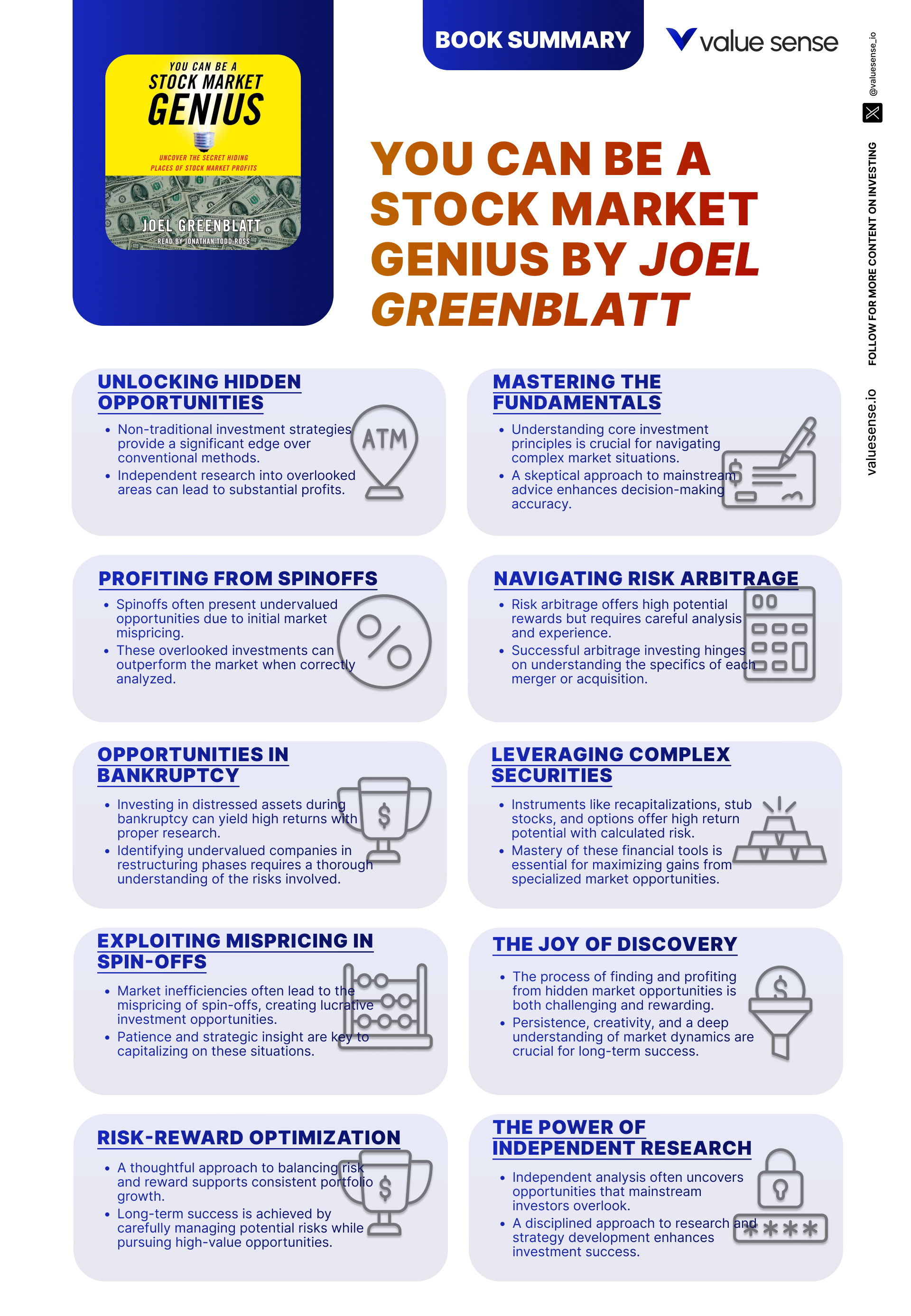
The primary theme of "You Can Be a Stock Market Genius" is that individual investors can achieve extraordinary returns by targeting overlooked and misunderstood areas of the stock market. Greenblatt demystifies complex situations and demonstrates, with vivid real-world examples, how these opportunities arise and how diligent research can turn them into substantial profits. The book’s purpose is not merely to teach theory but to arm readers with the practical tools and mindset necessary to uncover and capitalize on these special situations.
This book is considered essential reading for anyone interested in value investing, special situations, or seeking an edge over the broader market. It is especially valuable for self-directed investors, analysts, and professionals who want to go beyond traditional value screens and develop a deeper understanding of how to identify and exploit unique investment opportunities. Greenblatt’s writing is peppered with wit, clarity, and a healthy skepticism of Wall Street orthodoxy, making the book both educational and enjoyable.
What distinguishes "You Can Be a Stock Market Genius" from other investment books is its unapologetically practical focus. While many texts dwell on broad principles or academic theory, Greenblatt dives into the nitty-gritty of spinoffs, risk arbitrage, bankruptcies, and more—providing detailed case studies, checklists, and actionable advice. The book’s enduring popularity is a testament to its ability to empower readers to think independently, conduct rigorous research, and ultimately, achieve superior investment results by venturing where others fear to tread.

Key Themes and Concepts
Throughout "You Can Be a Stock Market Genius," Joel Greenblatt weaves together several interconnected themes that challenge conventional wisdom and empower investors to seek out exceptional returns. Rather than advocating for passive investing or broad market exposure, Greenblatt focuses on exploiting market inefficiencies and special situations that are often overlooked by institutional investors. His approach is grounded in a deep understanding of market psychology, risk management, and the importance of aligning incentives between management and shareholders.
These themes are not presented in isolation; instead, they recur throughout the book, often illustrated with detailed case studies and practical examples. By understanding these core concepts, investors gain a toolkit for navigating complex market environments, identifying unique opportunities, and avoiding common pitfalls. Below, we explore the most significant themes that underpin the book’s enduring relevance and practical utility.
- Market Inefficiencies: Greenblatt’s central argument is that the stock market is far from perfectly efficient, especially in the realm of special situations. He demonstrates that individual investors can consistently outperform professionals by focusing on areas where information is scarce, complexity is high, or institutional constraints limit participation. Examples include spinoffs, bankruptcies, and restructurings—situations where price discovery is often flawed due to forced selling, lack of analyst coverage, or uncertainty. Greenblatt’s own experience exploiting these inefficiencies forms the backbone of his investment philosophy, and he provides data showing how these situations have historically delivered outsized returns. For investors, the lesson is clear: seek out the corners of the market where inefficiency thrives, and be prepared to do the hard work of independent research.
- Spinoffs as Investment Opportunities: One of the book’s most actionable themes is the consistent outperformance of spinoffs—when a company separates a division or subsidiary into a new, independent entity. Greenblatt explains that spinoffs often result in mispriced stocks because parent company shareholders may sell the new shares indiscriminately, regardless of value. Additionally, management incentives in newly independent companies are frequently better aligned with shareholder interests. The book provides numerous case studies of spinoffs that delivered exceptional returns, emphasizing the importance of understanding the motivations behind the transaction and the potential for operational improvement. Investors are encouraged to analyze spinoffs for hidden value, management quality, and strategic positioning.
- Risk Management: A recurring theme is the necessity of understanding and managing risk. Greenblatt cautions against blindly chasing high returns without a clear grasp of potential downsides. He outlines practical frameworks for evaluating risk in complex situations such as bankruptcies, restructurings, and risk arbitrage. The book stresses the importance of margin of safety, position sizing, and scenario analysis. Greenblatt’s approach is both quantitative and qualitative—he advocates for thorough due diligence, understanding the capital structure, and anticipating worst-case scenarios. For investors, the key takeaway is that superior returns are only meaningful if achieved with prudent risk controls in place.
- Insider Incentives: Greenblatt repeatedly highlights the significance of management incentives and insider ownership. He argues that the best investment opportunities often arise when management teams have substantial “skin in the game,” aligning their interests with those of shareholders. The book provides frameworks for assessing management compensation, stock ownership, and recent insider activity. By focusing on situations where insiders are motivated to create value, investors can increase their odds of success. Case studies illustrate how misaligned incentives can lead to subpar outcomes, while well-aligned management teams often drive exceptional performance.
- Advanced Investment Techniques: The book introduces readers to advanced strategies such as risk arbitrage, stub stocks, options, warrants, and other derivatives. Greenblatt demystifies these instruments, explaining how they can be used to construct asymmetric risk/reward profiles and leverage unique market situations. He cautions that these techniques require specialized knowledge and careful risk assessment, but when used appropriately, they can significantly enhance returns. The book’s practical approach includes step-by-step analyses, real-world examples, and checklists for evaluating complex opportunities.
- Practical Application: Perhaps the most valuable theme is Greenblatt’s insistence on practical application. Every concept is grounded in real-world case studies, detailed calculations, and actionable checklists. The book is designed not just to inform, but to empower readers to implement the strategies themselves. Greenblatt provides guidance on sourcing ideas, conducting due diligence, and monitoring investments over time. Readers are encouraged to build their own investment process, adapt strategies to their unique circumstances, and continuously refine their approach based on experience and results.
- Continuous Learning and Improvement: Greenblatt’s tone is humble and encouraging, emphasizing that successful investing is a journey of ongoing learning. He shares stories of mistakes and missed opportunities, reinforcing the idea that even the best investors are always refining their craft. The book encourages readers to stay curious, question assumptions, and embrace setbacks as opportunities for growth. This mindset is essential for long-term success, especially in the unpredictable world of special situation investing.

Book Structure: Major Sections
Part 1: Introduction to Investment Strategies
This opening section, encompassing Chapters 1 and 2, lays the foundation for the entire book by introducing the reader to the basic principles of investing and the unique opportunities available in the stock market. Greenblatt sets the tone by challenging the efficient market hypothesis and emphasizing the potential for individual investors to outperform professionals. He discusses the importance of independent research, understanding risk and reward, and developing a contrarian mindset.
Key concepts in this section include the identification of market inefficiencies, the pitfalls of relying on professional analysts, and the necessity of doing your own homework. Greenblatt uses anecdotes and data to show that institutional investors are often constrained by size, mandates, or herd mentality, leaving lucrative opportunities for the diligent individual. The section also explores the psychology of investing, highlighting common biases and mistakes that can lead to suboptimal outcomes.
For investors, the practical application is clear: success in the stock market requires a willingness to think independently, question consensus views, and invest the time and effort needed to uncover hidden value. Greenblatt provides early checklists and frameworks for evaluating opportunities, setting the stage for the more advanced strategies discussed later in the book.
In today’s market, where information is ubiquitous but true insight remains scarce, these lessons are as relevant as ever. The proliferation of passive investing and algorithmic trading has arguably increased the number of overlooked opportunities for those willing to dig deeper. Greenblatt’s call to action—to be curious, skeptical, and persistent—remains timeless advice for investors of all experience levels.
Part 2: Special Investment Situations
Covering Chapters 3, 4, and 5, this section delves into the heart of Greenblatt’s strategy: exploiting special situations such as spinoffs, risk arbitrage, and bankruptcy investments. These are areas where market inefficiencies are most pronounced and where thorough research can yield outsized returns. Greenblatt explains the mechanics of each situation, the reasons why they are often mispriced, and the characteristics that make them attractive to savvy investors.
Key concepts include the consistent outperformance of spinoffs, the nuanced risk/reward profiles of merger arbitrage, and the potential windfalls available in distressed securities. Greenblatt provides detailed case studies, including specific examples of successful spinoff investments and bankruptcies that led to dramatic recoveries. He also cautions about the risks involved, emphasizing the importance of deep due diligence and risk management.
Investors can apply these insights by developing a process for sourcing, analyzing, and monitoring special situations. This includes screening for upcoming spinoffs, understanding the motivations of management, and carefully evaluating the capital structure and legal environment in bankruptcy cases. Greenblatt’s frameworks and checklists help investors avoid common pitfalls and focus on high-probability opportunities.
In the modern era, special situations remain fertile ground for alpha generation. While competition has increased, the complexity and idiosyncrasies of these situations continue to limit participation by larger funds. Individual investors with the right tools and mindset can still find significant opportunities, particularly in smaller-cap and less-followed companies.
Part 3: Advanced Investment Techniques
This section, encompassing Chapters 6 and 7, introduces readers to more sophisticated investment instruments and strategies, including stub stocks, options, warrants, and LEAPS. Greenblatt demystifies these tools, explaining how they can be used to create asymmetric risk/reward profiles and enhance returns in special situations. He provides practical guidance on when and how to use these instruments, as well as the risks involved.
Key concepts include the identification of stub stock opportunities—where a company’s remaining assets are undervalued after a divestiture—and the strategic use of options and warrants to capitalize on volatility and mispricing. Greenblatt uses real-world examples and step-by-step calculations to illustrate how these instruments can be integrated into an overall investment strategy.
For investors, the application of these advanced techniques requires a solid understanding of the underlying securities, the ability to model various scenarios, and a disciplined approach to risk management. Greenblatt’s advice is to use these tools selectively and only when the odds are clearly in your favor. He provides checklists and decision frameworks to help investors assess whether a particular situation merits the use of leverage or derivatives.
In today’s markets, options and other derivatives are more accessible than ever, but their misuse can be disastrous. Greenblatt’s balanced approach—emphasizing both the potential and the pitfalls—serves as a valuable guide for investors seeking to move beyond traditional buy-and-hold strategies. The principles outlined in this section are directly applicable to modern event-driven and special situation investing.
Part 4: Practical Application and Case Studies
The final section, Chapter 8, brings together the book’s key concepts through practical advice and detailed case studies. Greenblatt illustrates how the strategies discussed throughout the book can be implemented in real-world scenarios, highlighting both successes and failures. This section is designed to help readers bridge the gap between theory and practice, providing actionable insights and lessons learned from years of experience.
Key concepts include the importance of continuous learning, the value of post-mortem analysis, and the need to adapt strategies based on changing market conditions. Greenblatt shares stories of investments that went according to plan, as well as those that did not, emphasizing the importance of humility, flexibility, and perseverance. He also provides guidance on building a personal investment process and cultivating the right mindset for long-term success.
Investors can apply these lessons by maintaining detailed records of their investments, regularly reviewing outcomes, and seeking feedback from trusted peers or mentors. Greenblatt’s emphasis on process over outcome is particularly relevant in a world where short-term results can be misleading. By focusing on continuous improvement, investors can increase their odds of sustained success.
In the current market environment, the ability to adapt and learn from experience is more important than ever. The rapid pace of change, increased competition, and evolving regulations mean that investors must be nimble, curious, and resilient. Greenblatt’s practical wisdom provides a blueprint for thriving in any market environment.
Deep Dive: Essential Chapters
Chapter 1: Follow the Yellow Brick Road—Then Hang a Right
This opening chapter is critically important because it sets the philosophical and practical foundation for the rest of the book. Greenblatt immediately challenges the notion that the average investor cannot beat the market, asserting that special situations offer unique opportunities for outsized returns. He introduces the concept of market inefficiency, arguing that while markets are generally efficient, pockets of inefficiency exist—especially in less-followed, more complex areas. The chapter is loaded with anecdotes about institutional constraints and how they create opportunities for nimble, independent investors. Greenblatt’s tone is both irreverent and encouraging, inviting readers to question orthodoxy and embrace a more active, research-driven approach.
Throughout the chapter, Greenblatt provides data showing that many professional managers underperform the market, despite their resources and expertise. He cites studies and real-world examples where individual investors, armed with the right knowledge and willingness to do the work, have outperformed institutional funds. One memorable example involves the forced selling of spinoff shares by mutual funds, which creates temporary mispricing. Greenblatt also references his own investment successes and failures, emphasizing the importance of learning from mistakes and remaining humble.
Investors can apply these lessons by seeking out areas where institutional investors are absent or constrained, such as small-cap spinoffs, bankruptcy situations, and other special situations. Greenblatt encourages readers to develop independent research processes, avoid groupthink, and focus on opportunities that others overlook. He provides early checklists for evaluating market inefficiencies, such as analyzing trading volumes, insider activity, and recent corporate events.
Historically, the insights from this chapter have proven prescient. For example, during the late 1990s and early 2000s, individual investors who focused on spinoffs and other special situations often outperformed the broader market. In today’s environment, where passive investing dominates and many funds are forced to adhere to rigid mandates, the opportunities for enterprising investors remain abundant. Greenblatt’s message—that the market is not always efficient and that hard work can pay off—remains as relevant now as it was at publication.
Chapter 2: Some Basics—Don't Leave Home Without Them
This chapter is foundational because it covers the essential principles that underpin successful investing. Greenblatt stresses the importance of understanding risk and reward, doing your own research, and avoiding overreliance on professional analysts. He argues that most investors fail not because they lack intelligence, but because they lack discipline, patience, and a clear understanding of the basics. The chapter is filled with practical advice on how to approach the market with a rational, skeptical mindset.
Greenblatt provides concrete examples of how investors can misjudge risk, such as chasing hot stocks or relying on superficial analysis. He shares stories of companies that appeared attractive on the surface but harbored hidden risks, as well as those that were overlooked due to temporary setbacks. The chapter includes quotes from legendary investors and data on the long-term performance of different strategies, reinforcing the importance of fundamentals. Greenblatt also introduces the concept of margin of safety, a key tenet of value investing.
For investors, the actionable takeaway is to build a solid foundation of knowledge before venturing into more complex strategies. Greenblatt recommends reading annual reports, understanding financial statements, and developing a checklist for evaluating opportunities. He emphasizes the need for patience, discipline, and a willingness to say no to most opportunities. By mastering the basics, investors can avoid common pitfalls and set themselves up for long-term success.
In historical context, the lessons from this chapter have helped countless investors avoid the speculative excesses that often precede market downturns. The dot-com bubble, the financial crisis, and other episodes of market mania all illustrate the dangers of ignoring fundamentals. Today, with the proliferation of information and the rise of algorithmic trading, the ability to focus on the basics and filter out noise is more important than ever. Greenblatt’s advice remains a timeless guide for investors at any stage.
Chapter 3: Chips Off the Old Stock: Spinoffs, Partial Spinoffs, and Rights Offerings
This chapter is a cornerstone of Greenblatt’s investment philosophy, focusing on the outsized returns available in spinoff situations. Greenblatt explains that spinoffs often result in mispriced stocks because parent company shareholders may sell the new shares without regard to value, either due to portfolio constraints or lack of interest. He details the mechanics of spinoffs, partial spinoffs, and rights offerings, showing how these corporate actions create fertile ground for value-oriented investors.
Greenblatt provides numerous case studies of successful spinoff investments, such as the example of American Express’s spinoff of Lehman Brothers, which delivered substantial returns to those who recognized its value. He shares data showing that spinoffs, on average, outperform the market by a significant margin. The chapter includes quotes from CEOs and insiders, highlighting the importance of management incentives and the potential for operational improvement in newly independent companies.
Investors can apply these lessons by screening for upcoming spinoffs, analyzing the motivations behind the transaction, and evaluating the quality of management. Greenblatt provides checklists for assessing whether a spinoff is likely to outperform, including factors such as insider ownership, debt levels, and the potential for strategic focus. He encourages investors to look for situations where the new company is being “dumped” by shareholders who do not appreciate its value.
Historically, spinoffs have continued to deliver strong performance, even as the strategy has become more widely known. The success of companies like PayPal (spun off from eBay) and AbbVie (spun off from Abbott Laboratories) illustrates the enduring relevance of this approach. Greenblatt’s insights into the psychology and mechanics of spinoffs remain a powerful tool for investors seeking an edge in today’s market.
Chapter 4: Don't Try This at Home: Risk Arbitrage and Merger Securities
This chapter is essential because it delves into the complex world of risk arbitrage, a strategy that involves betting on the successful completion of mergers and acquisitions. Greenblatt explains the intricacies of merger securities, including the various forms of consideration (cash, stock, or a combination) and the risks involved in each scenario. He discusses how to analyze the probability of deal completion and the potential returns available to those willing to navigate this high-stakes arena.
Greenblatt provides detailed examples of merger arbitrage situations, such as the acquisition of RJR Nabisco, and includes data on the historical success rates of different types of deals. He shares quotes from arbitrageurs and investment bankers, shedding light on the psychology of deal-making and the factors that can derail a transaction. The chapter also covers the importance of understanding regulatory risk, financing contingencies, and shareholder approval processes.
For investors, the practical application involves developing a framework for evaluating merger arbitrage opportunities, including assessing the likelihood of deal completion, analyzing the terms of the transaction, and modeling potential outcomes. Greenblatt provides checklists for identifying attractive deals and avoiding common pitfalls, such as deals with high regulatory risk or uncertain financing. He emphasizes the importance of diversification and position sizing in managing the unique risks of this strategy.
In real-world context, risk arbitrage has remained a popular strategy among hedge funds and sophisticated investors. The rise of SPACs, cross-border mergers, and complex transaction structures has created new opportunities and challenges. Greenblatt’s balanced approach—highlighting both the potential rewards and the risks—remains a valuable guide for those considering this strategy in today’s market.
Chapter 5: Blood in the Streets (Hopefully, Not Yours): Bankruptcy and Restructuring
This chapter is crucial because it explores the opportunities available in bankruptcy and restructuring situations—areas often avoided by traditional investors due to perceived risk and complexity. Greenblatt argues that distressed securities can offer substantial returns to those willing to do the work of understanding the legal and financial intricacies involved. He explains the bankruptcy process, the role of different stakeholders, and the factors that can lead to successful turnarounds.
Greenblatt provides case studies of companies that emerged from bankruptcy stronger and more profitable, such as Continental Airlines and Marvel Entertainment. He discusses the importance of analyzing the capital structure, understanding the rights of different classes of creditors, and evaluating the potential for operational improvement. The chapter includes data on the historical performance of post-bankruptcy equities and quotes from turnaround specialists.
Investors can apply these lessons by developing a process for identifying and analyzing distressed opportunities, including reviewing court filings, monitoring insider activity, and assessing the motivations of key stakeholders. Greenblatt provides checklists for evaluating the likelihood of a successful restructuring and the potential for equity holders to benefit. He emphasizes the need for rigorous risk management and a willingness to walk away from situations where the odds are unfavorable.
Historically, bankruptcy investing has delivered some of the most dramatic success stories in the market, but it also carries significant risks. The financial crisis of 2008 and the COVID-19 pandemic both created waves of distressed opportunities for those prepared to act. Greenblatt’s insights into the mechanics and psychology of bankruptcy investing remain highly relevant for today’s investors, especially as economic cycles create new waves of restructuring activity.
---
Explore More Investment Opportunities

For investors seeking undervalued companies with high fundamental quality, our analytics team provides curated stock lists:
📌 50 Undervalued Stocks (Best) overall value plays for 2025
📌 50 Undervalued Dividend Stocks (For income-focused investors)
📌 50 Undervalued Growth Stocks (High-growth potential with strong fundamentals)
🔍 Check out these stocks on the Value Sense platform for free!
---
Chapter 6: Baby Needs New Shoes Meets Other People's Money: Capitalizations and Stub Stocks, LEAPS, Warrants, and Options
This chapter is pivotal because it introduces readers to advanced investment instruments that can be used to enhance returns in special situations. Greenblatt explains the use of stub stocks (where a company’s remaining assets are undervalued after a divestiture), LEAPS (long-term equity anticipation securities), warrants, and options. He demystifies these tools, showing how they can create asymmetric risk/reward profiles and amplify gains in the right circumstances.
Greenblatt provides detailed examples of stub stock opportunities, such as the case of Liberty Media, where the market failed to properly value the remaining assets after a spinoff. He explains the mechanics of options and warrants, including how to calculate intrinsic value and assess the likelihood of different outcomes. The chapter includes quotes from professional options traders and data on the historical performance of various instruments.
For investors, the actionable takeaway is to use these advanced tools selectively and only when the odds are clearly in your favor. Greenblatt provides checklists for evaluating whether a situation merits the use of leverage or derivatives, including factors such as volatility, time horizon, and the quality of underlying assets. He emphasizes the importance of understanding the risks involved and avoiding overcomplication.
In modern markets, options and other derivatives are more accessible than ever, but they remain complex instruments that can lead to significant losses if misused. Greenblatt’s balanced approach—highlighting both the potential rewards and the dangers—serves as a valuable guide for investors considering these strategies. The principles outlined in this chapter are directly applicable to today’s event-driven and special situation investing.
Chapter 7: Seeing the Trees Through the Forest
This chapter is significant because it emphasizes the importance of focusing on individual investment opportunities rather than getting lost in the broader market narrative. Greenblatt argues that success comes from identifying and acting on a small number of high-conviction ideas, rather than attempting to predict macroeconomic trends or time the market. He encourages investors to concentrate their efforts on thoroughly researching specific situations and to be willing to act decisively when the odds are favorable.
Greenblatt provides examples of investors who achieved exceptional results by focusing on a handful of special situations, rather than diversifying broadly or chasing hot sectors. He shares quotes from legendary investors like Warren Buffett, who advocate for concentration and conviction. The chapter includes data on the performance of focused portfolios versus broadly diversified ones, reinforcing the value of deep research and selective investing.
For investors, the practical lesson is to develop a process for identifying high-conviction opportunities, conducting thorough due diligence, and building concentrated positions when appropriate. Greenblatt provides checklists for evaluating the quality of an idea, assessing risk, and determining position size. He emphasizes the importance of discipline and the willingness to wait for the right opportunities.
Historically, many of the world’s best investors have followed this approach, achieving superior results by focusing on a small number of well-researched ideas. In today’s market, where information overload is a constant challenge, the ability to filter out noise and concentrate on what matters is more valuable than ever. Greenblatt’s advice remains a cornerstone of successful investing.
Chapter 8: All the Fun's in Getting There
This final chapter is essential because it ties together the book’s concepts with practical advice and real-world case studies. Greenblatt reflects on his own investment journey, sharing stories of both triumphs and setbacks. He emphasizes the importance of continuous learning, humility, and perseverance, arguing that the process of investing is as rewarding as the outcomes themselves.
Greenblatt provides detailed case studies of successful investments, such as his experiences with spinoffs and distressed securities. He shares lessons learned from mistakes, including the importance of maintaining discipline and adapting to changing market conditions. The chapter includes quotes from fellow investors and data on the long-term performance of special situation strategies.
For investors, the actionable takeaway is to embrace the journey of investing, maintain detailed records of decisions and outcomes, and seek feedback from trusted peers or mentors. Greenblatt encourages readers to focus on process over outcome, continuously refine their strategies, and remain open to new ideas. He provides checklists for post-mortem analysis and ongoing improvement.
In real-world context, the ability to learn from both successes and failures is a hallmark of great investors. The rapid pace of change in today’s markets requires adaptability, curiosity, and resilience. Greenblatt’s closing advice—to enjoy the process and commit to lifelong learning—remains a powerful message for investors at every stage of their journey.

Practical Investment Strategies
- Screening for Spinoffs: Begin by monitoring corporate announcements, SEC filings (Form 10), and financial news for upcoming spinoffs. Use stock screeners to identify companies planning to distribute new entities. Focus on situations where the parent company’s shareholders are likely to sell the spinoff indiscriminately, such as when the new entity is smaller, less liquid, or outside the parent’s core industry. Evaluate management incentives, debt levels, and the strategic rationale for the spinoff. Build a watchlist and conduct deep due diligence on both the parent and the new company.
- Analyzing Management Incentives: Review proxy statements and insider filings to assess management compensation, stock ownership, and recent insider purchases. Favor situations where executives have substantial “skin in the game” and where incentive structures are closely tied to shareholder value creation. Use tools like SEC EDGAR and insider transaction databases to track changes in ownership and compensation. Avoid companies with misaligned incentives or excessive dilution from stock options.
- Event-Driven Arbitrage: Track announced mergers, acquisitions, and restructurings using databases like Bloomberg, Capital IQ, or public M&A trackers. Analyze the terms of the deal, including consideration (cash, stock, or mixed), regulatory hurdles, and financing contingencies. Model the probability of deal completion and calculate potential annualized returns. Diversify across multiple deals to mitigate idiosyncratic risk, and avoid situations with high regulatory or financing uncertainty.
- Distressed Securities Investing: Monitor bankruptcy filings, distressed debt auctions, and restructuring announcements. Use legal databases and court filings to understand the capital structure, creditor hierarchy, and likely outcomes. Focus on companies with viable core businesses and potential for operational improvement post-restructuring. Assess the motivations of key stakeholders, including creditors, management, and equity holders. Be prepared for long holding periods and significant volatility.
- Stub Stock and Sum-of-the-Parts Analysis: Identify companies with multiple business segments, especially those undergoing divestitures or complex transactions. Use financial statements to break down the value of each segment and compare the implied valuation to the market price. Look for situations where the market undervalues the remaining “stub” after a transaction. Validate your analysis with peer comparisons and recent transaction multiples. Consider using options or warrants to enhance returns if available.
- Options and Warrants for Special Situations: Use options and warrants to create asymmetric risk/reward profiles in event-driven situations. For example, buy long-term call options (LEAPS) on companies expected to benefit from a spinoff or restructuring. Analyze implied volatility, time to expiration, and the likelihood of the catalyst event. Avoid overleveraging and ensure that you understand the risks and mechanics of each derivative.
- Building a Focused Portfolio: Concentrate your portfolio in a small number of high-conviction ideas rather than diversifying broadly. Allocate capital based on your assessment of risk, potential reward, and your confidence in the analysis. Regularly review and rebalance the portfolio, trimming positions as catalysts play out or as new opportunities arise. Maintain detailed records of investment theses, outcomes, and lessons learned for continuous improvement.
- Continuous Learning and Process Improvement: After each investment, conduct a post-mortem analysis to identify what worked and what didn’t. Track your performance against relevant benchmarks and document key decision points. Seek feedback from mentors or fellow investors, attend conferences, and read widely to stay abreast of new strategies and market developments. Use tools like investment journals, checklists, and performance dashboards to systematize your process.

Modern Applications and Relevance
The principles outlined in "You Can Be a Stock Market Genius" remain highly relevant in today’s rapidly evolving investment landscape. While the proliferation of information and the rise of algorithmic trading have made markets more efficient in some respects, the core message of the book—that inefficiencies persist in overlooked and complex situations—still holds true. Special situations such as spinoffs, restructurings, and distressed securities continue to offer fertile ground for enterprising investors willing to do the work.
Since the book’s publication, the market has seen several waves of innovation, including the rise of ETFs, the democratization of data, and increased regulatory scrutiny. While these changes have made some strategies more competitive, they have also created new opportunities. For example, the explosion of SPACs (special purpose acquisition companies) in recent years has introduced a new class of special situations, many of which share characteristics with the spinoffs and restructurings described by Greenblatt. Similarly, the increased prevalence of activist investing and shareholder engagement has led to more frequent corporate actions, providing a steady stream of potential opportunities.
What remains timeless is the importance of independent research, critical thinking, and disciplined risk management. Greenblatt’s emphasis on understanding management incentives, conducting deep due diligence, and focusing on process over outcome is as valuable today as it was in the late 1990s. The book’s practical frameworks and checklists can be readily adapted to modern tools and datasets, allowing investors to screen for special situations, analyze complex transactions, and monitor insider activity with greater efficiency and accuracy.
Modern examples abound: PayPal’s spinoff from eBay, AbbVie’s emergence from Abbott Laboratories, and the wave of bankruptcies during the COVID-19 pandemic all illustrate the enduring relevance of Greenblatt’s strategies. Investors who applied the book’s principles to these situations were often rewarded with outsized returns. At the same time, the increased speed and transparency of today’s markets mean that investors must act quickly and decisively, leveraging technology and data to maintain an edge. Greenblatt’s advice to remain humble, continuously learn, and adapt to changing conditions is more important than ever in a world where yesterday’s edge can quickly become today’s baseline.
Most investors waste time on the wrong metrics. We've spent 10,000+ hours perfecting our value investing engine to find what actually matters.
Want to see what we'll uncover next - before everyone else does?
Find Hidden Gems First!
Implementation Guide
- Develop a Research Workflow: Start by setting up a system to monitor news, SEC filings, and corporate actions for special situations such as spinoffs, mergers, and bankruptcies. Use tools like Value Sense’s stock screener, SEC EDGAR, and financial news aggregators. Dedicate time each week to reviewing potential opportunities and building a watchlist. Document your research process to ensure consistency and thoroughness.
- Build Foundational Knowledge (1-2 months): Spend the first 1-2 months immersing yourself in the basics of financial statement analysis, valuation techniques, and the mechanics of special situations. Read annual reports, proxy statements, and filings related to recent spinoffs or restructurings. Supplement your learning with resources such as investment books, online courses, and webinars focused on value investing and event-driven strategies.
- Construct a Focused Portfolio: Once you have identified high-conviction opportunities, allocate capital based on your assessment of risk, potential reward, and your confidence in the analysis. Limit the number of positions to those where you have done the deepest research, typically 5-10 core holdings. Use position sizing rules to manage risk, such as limiting any single position to 10-15% of the portfolio. Rebalance periodically as catalysts play out or new opportunities emerge.
- Establish an Ongoing Review Schedule: Set a regular schedule for reviewing your portfolio and research process—at least monthly, with a deeper review each quarter. Monitor news, earnings reports, and insider activity related to your holdings. Update your investment theses as new information becomes available. Track performance against relevant benchmarks and adjust your process as needed to address weaknesses or capitalize on strengths.
- Commit to Continuous Improvement: After each investment, conduct a post-mortem analysis to identify what worked and what didn’t. Maintain an investment journal to document key decisions, outcomes, and lessons learned. Seek feedback from mentors, participate in investment communities, and stay current with new research and strategies. Use tools like Value Sense’s intrinsic value models, financial dashboards, and stock screeners to refine your process and stay ahead of the curve.
--- ---
10+ Free intrinsic value tools

For investors looking to find a stock's fair value, our analytics team has you covered with intrinsic value tools:
📍 Free Intrinsic Value Calculator
📍 Reverse DCF & DCF value tools
📍 Peter Lynch Fair Value Calculator
📍 Ben Graham Fair Value Calculator
📍 Relative Value tool
...and plenty more.
🔍 Explore all these tools for free on the Value Sense platform and start discovering what your favorite stocks are really worth.
FAQ: Common Questions About You Can Be a Stock Market Genius
1. Is "You Can Be a Stock Market Genius" suitable for beginners?
Yes, while the book covers advanced strategies, Greenblatt explains concepts in a clear and accessible way, making it suitable for motivated beginners. The early chapters focus on foundational principles and the importance of independent research, which are essential for all investors. As readers progress, they can gradually tackle more complex topics like spinoffs and risk arbitrage. The book’s practical examples and actionable checklists help bridge the gap between theory and practice for those new to investing.
2. How relevant are the book's strategies in today's market?
The strategies described in the book remain highly relevant, especially for those willing to look beyond traditional value screens. Special situations like spinoffs, restructurings, and distressed securities continue to offer opportunities for superior returns. While competition has increased and information is more widely available, the complexity and idiosyncrasies of these situations still limit participation by larger funds. Investors who apply Greenblatt’s frameworks and adapt them to modern tools can continue to find attractive opportunities.
3. What are the main risks associated with special situation investing?
Special situation investing involves unique risks, including deal failure in arbitrage, misjudging management incentives, and the complexities of bankruptcy or restructuring. These situations often require deep research and a willingness to accept volatility and uncertainty. Greenblatt emphasizes the importance of risk management, diversification, and a disciplined process to mitigate these risks. Investors should be prepared for setbacks and ensure that their position sizes reflect the potential for loss as well as gain.
4. How much capital do I need to implement the book's strategies?
Many of the book’s strategies can be implemented with modest amounts of capital, particularly in small-cap spinoffs and less-followed special situations. Some advanced techniques, like risk arbitrage or distressed debt, may require larger positions or access to specialized markets. However, Greenblatt’s core message is that individual investors with limited resources can still achieve exceptional returns by focusing on overlooked opportunities and conducting thorough research. The key is to start small, build experience, and scale up as confidence and expertise grow.
5. What tools and resources can help me apply Greenblatt’s strategies?
Investors can leverage a variety of tools to apply the book’s strategies, including stock screeners (such as Value Sense), SEC EDGAR for filings, financial news aggregators, and insider transaction databases. Advanced investors may also use options analysis platforms, bankruptcy court databases, and M&A trackers. Building a network of fellow investors and mentors, participating in online communities, and maintaining an investment journal are also valuable for continuous learning and improvement. Greenblatt’s checklists and frameworks can be adapted to modern software and data sources for greater efficiency and insight.